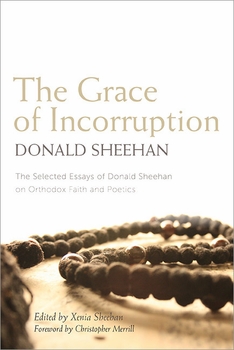
 Years ago I was assigned a new prayer rule by my spiritual father, the reading of the daily selections of the Psalms, the kathismata. At the time, we lived next door to the church and I would dutifully read or chant the Psalms morning and evening in the temple. Somewhere along the way my rule was either changed, or I lapsed; I cannot remember which. Passing years saw me fondly recall that discipline, but it was only upon reading Donald Sheehan’s book, The Grace of Incorruption, that I once again fell in love with God in the Psalms. I am in Donato’s debt.
A happy coincidence occurred when, having just finished The Grace of Incorruption, I attended Camp St Raphael, our annual church youth camp, in Oklahoma. The other priest serving that week, Fr Mark Haas and I had done this stint together a number of times in the past. Upon retiring the first night, we noticed that each of us had brought just two books to camp – the same two books: The Psalter[1] and the new book by Metropolitan Hierotheos (Vlachos), “I Know A Man in Christ” – Elder Sophrony the Hesychast and Theologian.[2] I related to Fr Mark how I had just finished The Grace of Incorruption which had rekindled my habit of the daily Psalm readings. Each evening, and in spare time, found each of us plowing through one or other of these works.
This brings me to another coincidence: my previous rule of prayer. Like Sheehan, though not nearly as dramatically, I began the practice of the Jesus Prayer years before converting to Orthodox Christianity. While an Episcopalian in seminary, a friend who had converted to Eastern Orthodoxy sent me a prayer rope and the words of the Jesus Prayer: “Lord Jesus Christ, Son of God, have mercy on me, a sinner.”I mentioned at the outset that my spiritual father had changed my rule, giving me the daily reading of the Psalter. That which was replaced was my previous rule of three hundred Jesus Prayers each day. And it is here, with the Jesus Prayer that Sheehan’s posthumous anthology begins:
At dawn on April 4 [1976], I was all of a sudden awakened, fully and completely. What awoke me were these words sounding in my mind: Lord Jesus Christ, Son of God, have mercy on me, a sinner. For an instant I thought someone had spoke aloud, but then I realized the words were in me. I sat up, fresh and alert. The words repeated themselves. And then repeated again. I looked over at the window, and the first light of dawn was coming in (pp.6-7).
He goes on, to beautiful and moving effect, to relate his journey with this great gift, the Jesus Prayer. What ties all of these happenings together is the pursuit, for lack of a better word, of stillness. “St Isaac the Syrian, the seventh-century Orthodox saint whose writings on the way of stillness have shaped the Orthodox understanding of prayer for thirteen centuries, says: ‘If you love repentance, love stillness also,’ adding that stillness is ‘the mother of repentance’” (p.84).
For Isaac – and, indeed, for all Eastern Orthodox ascetic teaching – stillness can be defined as the voluntary practice of separating oneself from every anxiety, both one’s own and others’. Now as one astute commentator on Isaac says: “The state of stillness of mind is not acquired by human effort alone but is a gift.” Isaac says: “No one is so stupid as to want to find this by means of struggle and the strength of his own will, for this is the gift of the revelation to the intellect, and it is not … a matter of the will.” And yet – here is the key – you must be attentive, even expectant, that the gift of stillness truly exists in God’s hands and that He greatly wishes to give it to you. You cannot will the gift of stillness. But you must choose actively to await its giving (p.109).
The stage is thus set, in the first part of the book, to present us with Sheehan’s wonderful and thorough exposition of Psalm 118:
In the entire 176 lines of this immense psalm, only the first four lines do not have both “I” and “thou” actively present: for this grace of relationship between the human and the divine is the whole poem’s clear pattern. The significance of this pattern is, at every moment, equally clear: the pattern teaches us the way of stillness. The way in which the psalm accomplishes this can best be suggested by noting this: what instantly unmakes in us any practice of stillness we may attempt is the way our minds cling to – and incessantly replay – our resentments and angers and grievances, imagined or real. The pattern of relationship that every stanza of the twenty-two in this poem sustains, directly teaches the way to surrender our mind’s clinging to its angers and resentments. And once again: we can enter into that dance of blessedness only when we voluntarily choose to walk in the law of the Lord, to search more deeply into His testimonies, and to seek Him with our whole heart (p.111).
But the magic, if you will, of Psalm 118 – its lyrical verse and response, human and divine – is found throughout the Psalter in poetic patterns. Sheehan writes, “Psalmic poetics everywhere presupposes the active reality of distinct yet related voices: the voices of the psalmists … and the divine voice of God” (p.121). And, continuing in this thread:
The fallen reason thus breaks open. Yet once so broken – and it is broken in the action of every psalm – the mind of David can then be lyricized by God – enlarged, made new, illumined, by David’s love for God and God’s for him. Now, amidst the very brokenness, he can begin to sing that wholeness and healing which God himself is singing: “O Lord, thou shalt open my lips and my mouth shall declare thy praise” (Ps.50:15). By singing the psalm, the Davidic mind heals itself and all the world (p.125).
This lyrical alchemy, while obvious in many Psalms – and appreciated in practice – is charismatically (mystically?) gifted in the diapsalma.[3] Sheehan notes that St Gregory of Nyssa devotes an entire chapter to the meaning of diapslama in his Treatise on the Inscriptions [or Titles] of the Psalms. St Gregory writes:
Diapsalma is a pause which occurs suddenly in the midst of the singing of a psalm in order to receive an additional thought which is being introduced by God. Or, one might rather define it as follows. Diapsalma is a teaching from the Spirit which occurs in a mysterious manner in the soul when the attention given to this (new) though impedes the continuity of the song” (p.151).
Sheehan also notes the empirical power within the recitation of the Psalms:
One other part of my experience in psalmic prayer is also, I think, worth mentioning here. To pray the Psalms regularly is to be attached unceasingly. And the effects of ceaseless demonic attack are flatness of speech and restlessness of mind and a consequent vanishing of sweetness of vision and the disappearance of any or all dynamis (power) … If I try to battle directly the attack, then I immediately open the door to mental restlessness; if I try simply to lie low, then spiritual flatness instantly ensues. The only hope I have in such moments (and they are frequent indeed) is to stay as attentive as I can to the psalm’s actual works as they are occurring to me. For psalmic dynamis – the power of the Psalms – is coming not at all from me but solely from the poems themselves (p.154).
 I highly recommend this book for those who regularly pray the psalter or who wish to enter into praying the psalter; for the casual reader, it may prove slow slogging. This is not negative criticism, but a truthful encouragement: pray the Psalms! Yet, had I not previously done so – regularly prayed the Psalms – I would not have appreciated this work in the same depth or light. It’s deep. Which brings me ‘round to the title of this reflection, particularly alchemical oratory:
In making our approach to the subject of psalmic poetics, three points are important at the outset. First, psalmic poetics are aural and oral – in the ear and mouth – sung (chanted), not silently read. Second, psalmic poetics are communal, holding meaning for the entire Israelite community. Third, psalmic poetics are actions of blessedness, actions that secure whole communities from demonic human violence …” (p.120).
That is to say, if I may, that the daily recitation of the Psalms, like the Jesus Prayer, is a way to stillness – as in, “Be still and know that I am God” (Ps.45).
_____________________________________________________________
[1] The Psalter According to the Seventy, Holy Transfiguration Monastery, Boston – 2007.
[2] Fr Sophrony is well known for his and his monastery’s practice of the Jesus Prayer.
[3] “Diapsalma” is the Greek Septuagint equivalent of the Hebrew word “Selah”. This word, which is only found in the poetical books of the Old Testament, occurs some 70 times in the Psalms. This term had a musical significance in the ancient Hebrew singing of the Psalms. There are various views, but St John Chrysostom took it to mean the part of a Psalm that was assigned to another choir. St Gregory of Nyssa took it to mean a pause. [(Bp) John Shaw, taken from an Orthodox list comment]

 The ol’ peepers just ain’t what they used to be. Ten years ago I was assisting with a funeral with eight other clergy. For the first time I was having trouble seeing the service book and holding it further, closer, etc, when a Greek priest said: “Fr Joseph! Where are your glasses?” I smiled proudly and said, “I don’t wear glasses.” He hissed: “I know. WHERE are your glasses? That afternoon, I bought my first pair of Readers.

 Orthodixie