Efforts to Have Justices Ginsburg and Kagan Recuse Take A Troubling Turn

​By Herbert W. Titus & William J. Olson; June 19, 2015

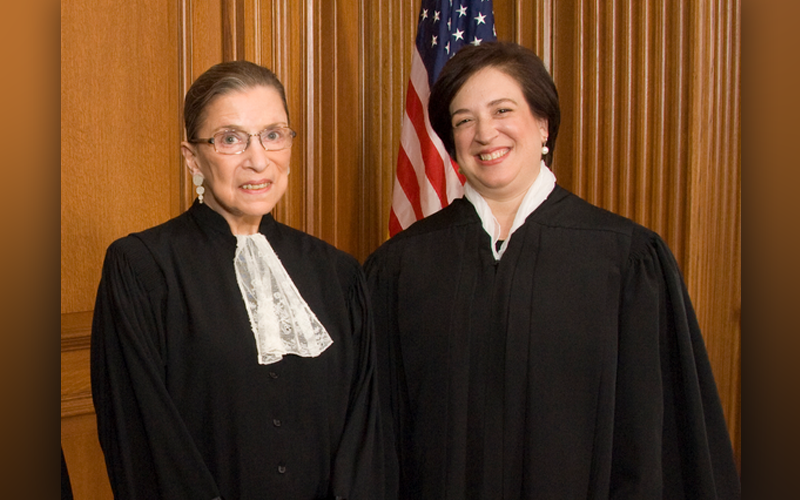
ginsburg_kagan_800x500On June 17, 2015, former U.S. Magistrate Judge Joe Miller wrote and published an article calling for Justices Ruth Bader Ginsburg and Elena Kagan to recuse from participating in the consolidated same-sex marriage cases now pending before the U.S. Supreme Court on the ground of bias. In support, Miller noted that both justices had officiated in the marriage ceremonies of same-sex couples, and that Justice Ginsburg had gone so far as to strongly suggest in public that the time for same-sex marriage had arrived.

​In the course of his article, Miller also reported that the Foundation for Moral Law, which had submitted a friend-of-the-court brief in favor of traditional marriage, had also submitted a motion in support of Justices Ginsburg’s and Kagan’s recusals. Importantly, Miller also reported that not only had the Court not ruled on the Foundation’s motion, but that the motion had not even been posted on the Supreme Court docket. While a delay in posting can occur for a number of reasons, none applied here. Did someone at the High Court not want to acknowledge that such a motion had been filed?

​Now we may have some indication that the U.S. Supreme Court uses Google Alerts, because shortly after the Miller article was published, on either June 17 or 18, 2015, the Foundation’s recusal motion suddenly appeared on the docket of the U.S. Supreme Court. Under a date of May 21, 2015, the entry read: “Request for recusal received from amicus curiae Foundation for Moral Law.” The new entry raises new questions.

​First, the missing motion. The Foundation’s first motion to recuse consisting of eight pages was submitted on April 27, 2015 (and date and time stamped on April 27, 2015, at 11:47 a.m.) — a good three weeks before the Supreme Court claims that it was “received” on May 21, 2015. The Foundation for Moral Law later filed a second motion to recuse consisting of four pages on May 21 (date and time stamped on May 21, 2015, at 11:28 a.m.). The second motion was filed after Justice Ginsburg performed another same-sex wedding, and was to the effect of:“there, you did it again.” The second motion refers back to the first motion. Why is there only one entry on the Court’s docket sheets? What happened to the original motion?

​Second, the name. The Foundation document is entitled a “Motion.” Why is it entitled on the docket as a “Request”?

​Third, the action. According to the Court rules, a “Motion” is “filed” with the Court. Why is the action taken by the Court described only as “received” and not “filed”?

​These points may appear to be minor – words that only lawyers would quibble over. But in reality, they suggest that the High Court, for an inordinate time, has ignored the recusal motion. While the Court has finally acknowledged that some recusal filing was made, it certainly gives no assurance that any ruling on the motion will be forthcoming before the Court decides the same-sex marriage case.

​Federal law requires judges and justices to recuse from any case in which their impartiality “may reasonably be questioned….” 28 U.S.C. section 455. Moreover, Canon 3A(6) of the Code of Conduct for United States Judges states: “A judge should not make public comment on the merits of a matter pending or impending in any court….” However, as this case is demonstrating, the Supreme Court appears to believe it is under no obligation to abide by that federal law and judicial Ethical rule.

​First, while Justices Ginsburg and Kagan have an ethical duty to avoid commenting on cases, and a statutory duty to recuse when their impartiality “may reasonably be questioned,” as a matter of practice, each justice is the sole judge of her own case. While a decision of a lower federal court judge may be appealed to a higher authority, each U.S. Supreme Court Justice has the final word on his own fitness to serve. These two Justices should have addressed the question publically prior to participating in oral argument (issue one and issue two) on April 28, 2015, but they did not. Since these two Justices ignored problems caused by their conduct, the remainder of the Court should have stepped in and addressed the issue for them, but the other seven Justices have remained silent.

Second, even now, the Foundation for Moral Law’s motion to recuse is not officially recognized by the High Court as being a motion, the docket sheets characterizing the motion as a mere “request.” Having no obligation to rule on a mere “request” — especially one that it represents was not even “filed” — Justices Ginsburg and Kagan would seem to be free to disregard the matter completely without obligation to give any reasons whatsoever why they could be impartial.

​The effort to have Justices Ginsburg and Kagan recuse is not just a lonely one of former federal Magistrate Judge Joe Miller from Alaska and the Foundation for Moral Law in Alabama. It is also supported by the American Family Association, Vision America Action, the National Organization for Marriage, the U.S. Justice Foundation and — in a story largely ignored by the mainstream media — supported by an unanimous vote of the Louisiana House of Representatives, as well as Louisiana Governor Bobby Jindal.

​Should Justices Ginsburg and Kagan continue to disregard their apparent conflict of interest, the long-standing legal maxim that no one should be a judge in his own case again would be upended. And if the motion is then disregarded by the Court as a whole, to which it was addressed secondarily, the opinion of the two justices on their own fitness to participate in the vote would stand. In either event, for many people, continued inaction on these recusal motions will not only erode public confidence in the U.S. Supreme Court, but would call into question the constitutional legitimacy of its forthcoming same-sex marriage decision.

______________

Herbert W. Titus taught Constitutional Law for 26 years, and concluded his academic career as the Founding Dean of Regent Law School. William J. Olson served in three positions in the Reagan Administration. Together they have filed over 80 briefs in the U.S. Supreme Court, and dozens more in lower courts, addressing important public policy issues. In the recent same-sex marriage cases, they filed an amicus curiae brief in the DeBoer case in the Sixth Circuit, and another amicus brief in the Obergefell case in the U.S. Supreme Court. They now practice law together at William J. Olson, P.C. They can be reached at traditionalmarriage@lawandfreedom.com or twitter.com/Olsonlaw.

This article is part of a series on “Building Resistance to Same-Sex Marriage” which appears on the USJF website. To support this important work, please make contributions the U.S. Justice Foundation. Permission is freely granted to publish, copy, reproduce, distribute, or excerpt from this article for any purpose

Posted in Uncategorized | Leave a comment

The Profound Consequences of Same Sex Marriage for Business and the Professions

Building the Resistance to Same-Sex Marriage
(fifth in a series of articles)

The Profound Consequences of Same Sex Marriage for Business and the Professions
J. Mark Brewer

pizza-weddingI was a law student when I first learned of the consequences of not being politically correct concerning homosexuality. A former Miss America’s contract as the citrus growers’ brand-ambassador was allowed to lapse because she had successfully campaigned for the repeal of a pro-homosexual ordinance in Miami-Dade County. She was quoted as saying, “What these people really want, hidden behind obscure legal phrases, is the legal right to propose to our children that theirs is an acceptable, alternate way of life.” She was publicly humiliated — “pied” on national television — and her name — Anita Bryant — became synonymous with something called “homophobia” and “hate speech.”

As a new Air Force J.A.G. officer, my first court assignment was to represent the United States in an administrative discharge proceeding concerning a female service member. She was being kicked out of the service for allegedly engaging in homosexual acts. Even as an inexperienced young lawyer, I managed to prove that she had committed the requisite two homosexual acts. She was given a “general” discharge and sent back to the United States.

I don’t remember when thereafter I first noticed that there are only two instances in which “sex” occurs in the “ethics” rules for lawyers. Both are in the same, “anti-discrimination” provision: “A lawyer shall not willfully, in connection with an adjudicatory proceeding … manifest, by words or conduct, bias or prejudice based on race, color, national origin, religion, disability, age, sex, or sexual orientation towards any person involved in that proceeding in any capacity.” There it was — right there with the prohibition racial discrimination; a lawyer could not “manifest” any “bias or prejudice” based on “sexual orientation.” Hadn’t I done precisely that just a few years earlier? Hadn’t I done that on behalf of the United States government? And yet in that case, I hadn’t set out to prove that the female service-member was a homosexual. My task was limited to proving that she had engaged in homosexual conduct.

Then, suddenly, the issue of homosexual rights — that is, not the right to be a homosexual — but the right to openly engage in homosexual practices and be insulated from any push back from the rest of society — was everywhere. Suddenly it had become a daily staple of bar journals and legal news sources. I don’t remember when I first noticed that. Was it when California’s voters approved a referendum that “only marriage between a man and a woman is valid or recognized in California”? It must have been before then. It must have been as early as 1993 when I first noticed the enormous consequences of this new so-called right. That was the year Travis County, Texas legalized “domestic partnerships,” in order to attract business investment to Austin, the state capitol.

Not until the spring of 2015, however, did the consequences of this new “right” really began to sink in for me. That’s when I knew that people who for years had thought that the emerging collection of special protections for homosexual behavior was, “no big deal,” were flat wrong. Indiana Gov. Mike Pence had signed a “religious freedom” bill. The backlash, in the name of homosexual rights, was ferocious with the now infamous threats and boycott of a small-town pizza joint whose owners had the temerity to volunteer that they would decline to cater a homosexual marriage celebration.

So, now we know that Anita Bryant was right — at least partly so — when she embarked on her doomed campaign nearly 40 years ago. Ms. Bryant primarily worried about children being confronted with a dangerous alternative way of life. Today, all opponents of special homosexual rights have cause to be worried about their very survival — legal and economic. Anyone who opposes the new Manifesto of homosexuality and gender neutrality/gender identity is at risk.

Using statutes originally and primarily (if not exclusively) designed to protect blacks from discrimination, activist homosexuals have targeted bakers, photographers, and florists, seeking to force all of them to promote a “marriage” that they believe to be immoral. One day, such laws probably will be deployed against writers of articles like this one.

In Washington State, a judge ruled that a florist violated the state’s anti-discrimination laws when she referred a longtime customer to another florist for the wedding flowers for his homosexual marriage. In New York, a husband and wife shut the doors to their business hosting weddings on their family farm, after a court fined them $13,000 for refusing to host gay marriages in their home. In Colorado, a baker faced jail time and stopped baking wedding cakes entirely, after a court ruled that he discriminated against a gay couple when he refused to bake them a cake for their wedding. In Oregon, a court found similarly against another baker, and he may be forced to pay a homosexual couple up to $150,000 as penalty. The New Mexico Supreme Court held that a photographer violated the state’s anti-discrimination statutes by refusing to photograph a gay wedding. Newspapers likely will be forced to publish homosexual wedding announcements, in violation of their existing editorial control over what they publish.

Even pro-same sex marriage, libertarian, John Stossel has said that the gay marriage movement “has moved from tolerance to totalitarianism.”

To homosexual activists and their political supporters, it matters not one whit that homosexuality is not consistent with Biblical sexual morality.

In this brave, new, homosexual-friendly world, every licensed professional would be required to embrace the new orthodoxy — to bow down to the idol of “non-discrimination,” or be cast out of his profession. I was co-counsel on an amicus brief against same-sex marriage in the Obergefell case; the Texas Attorney General also filed an amicus brief on behalf of the State of Texas against same-sex marriage. Does that put us in violation of the ethics rule previously quoted?

If the U.S. Supreme Court forces same-sex marriage on the states, unless the states resist such a ruling, the legal system will be employed to squash resistance to the new order. Lawyers who oppose this not-so-brave new world will begin to lose their right to practice law for violation of the new so-called “ethics” of the profession. An Obama Department of Health and Human Services will push for all physicians who stand up for Christian morality to be stripped of their hospital privileges and medical licenses.

According to the advocates of homosexual marriage in the U.S. Supreme Court, the right to a homosexual way of life is enshrined in the penumbras and emanations of the Fourteenth Amendment’s guarantee of Equal Protection — or is it Due Process — or both. (Apparently, this even explains why the Civil War itself was fought.) In fact, this new right is said by these advocates to be so deeply embedded in the Constitution that it trumps the First Amendment’s guarantees of freedom of speech, freedom of religion, and freedom of association. And it empowers government to run aspects of our lives that it has no business controlling.

The same people who first claimed only to only want tolerance of their behavior will allow no toleration for other views. Will a physician be forced to perform an artificial insemination for a lesbian couple? Will a lawyer be forced to take a case defending gay marriage? Lawyers are already losing their “traditional prerogative to exercise absolute discretion in the selection of clients….” Provisions designed to advance the homosexual agenda have been incorporated into many state legal ethics codes. In California, for example, it is unethical to “discriminat[e] on the basis of … sexual orientation [in] employment … or [client] representation….” State Bar of California, Rules of Professional Conduct: Rule 2-400B. If you doubt this view of the future, read R. Beg, License to Discriminate Revoked: How a Dentist Put Teeth In New York’s Anti-Discrimination Disciplinary Rule,” 64 Albany L. Rev. 154 (2000).

I fear that the legal system has lost its way, and the case now before the U.S. Supreme Court could well lay the groundwork for government to assume the sort of totalitarian powers required to force everyone to yield to what most of us hopefully still believe to be immoral. But it doesn’t have to be that way. Instead, right-thinking people can and should not be afraid to assert their God-given rights. They should not — must not – fail in their duty to teach Biblical sexual morality to their children despite state-sponsored interference. They should accept the challenge and obey their conscience — even if that means refusing totalitarian orders to bow down at the altar of homosexuality. We did not seek this war, but if it comes, we must not shirk from it.

_________________________

J. Mark Brewer, a former U.S. Air Force JAG officer, is a lawyer in Houston, Texas. He was co-counsel on an amicus brief filed in the Obergefell case before the Supreme Court.

This article is part of a series on “Building Resistance to Same-Sex Marriage.” Should you want to help support this important work, contributions may be made to the U.S. Justice Foundation.

Permission is freely granted to publish, copy, reproduce, distribute, or excerpt from this article for any purpose.

Posted in Uncategorized | Leave a comment

Find the Morality Missing in the Case for Natural Marriage, or Lose

Building the Resistance to Same-Sex Marriage
(third in a series of articles)

Find the Morality Missing in the Case for Natural Marriage, or Lose
By Robert R. Reilly; June 8, 2015

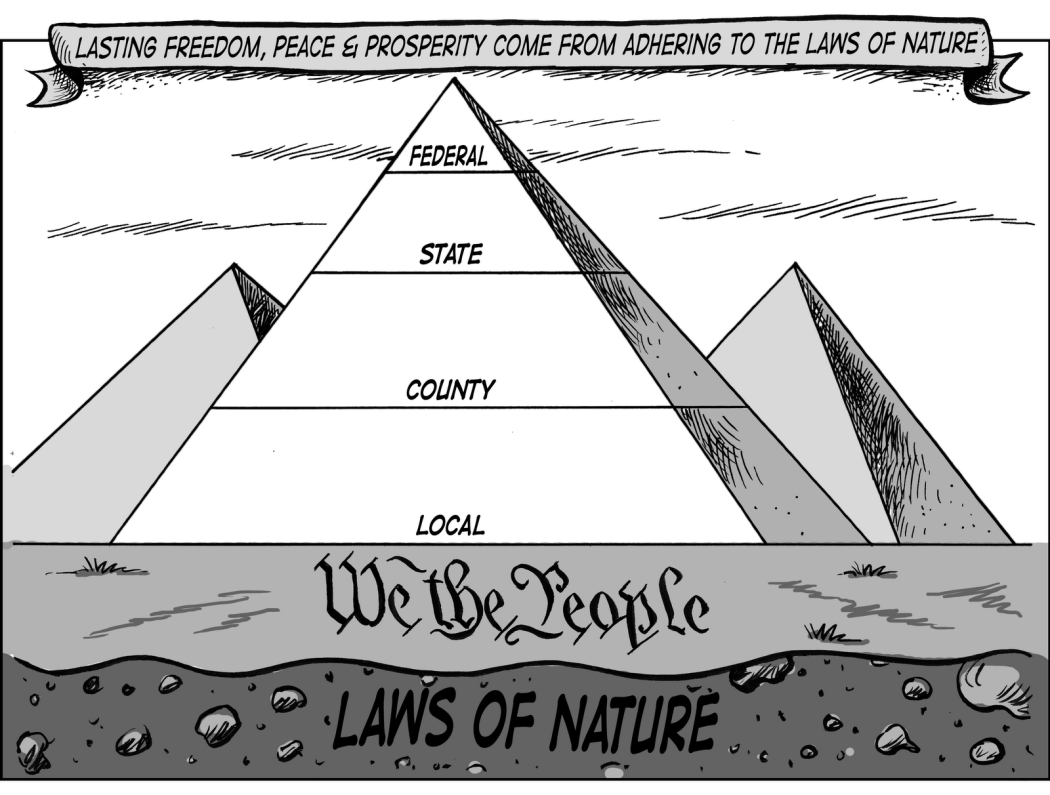
governance-pyramids-law-of-nature1-1050x795Why have the pro-natural family forces been losing in court? Intentionally or not, Judge Richard Posner explained the reason in a 7th Circuit Court ruling (Sept. 4, 2014), in which he decided against the Indiana and Wisconsin laws restricting marriage to a man and a woman:

“The state [Wisconsin] does not mention Justice Alito’s invocation [in the Windsor case] of a moral case against same-sex marriage, when he states in his dissent that ‘others explain the basis for the institution in more philosophical terms. They argue that marriage is essentially the solemnizing of a comprehensive, exclusive, permanent union that is intrinsically ordered to producing new life, even if it does not always do so.’ [U.S. v. Windsor, 133 S.Ct. 2675, 2718 (2013).] That is a moral argument for limiting marriage to heterosexuals. The state does not mention the argument because as we said, it mounts no moral arguments against same-sex marriage.” Baskin v. Bogan, 766 F.3d 648, 669 (7th Cir. 2014) (emphasis added).

While Justice Alito recognizes that there is a moral argument for limiting marriage to heterosexuals, it was not only the State of Wisconsin that failed to make such a case. Neither have the States of Michigan, Kentucky, Ohio, or Tennessee in Obergefell, the decisive case now before the U.S. Supreme Court. I believe that this is one of the key reasons that the pro-natural family position has been losing in most of the cases thus far.

With the moral foundation missing, an air of unreality pervades the federal court system. Let us see how unreal by looking at a couple of examples. When invalidating Oregon’s constitutional ban on same-sex marriage (May 19, 2014), U.S. District Judge Michael McShane wrote in his opinion,

“I believe that if we can look for a moment past gender and sexuality, we can see in these [same-sex] plaintiffs nothing more or less than our own families. Families who we would expect our constitution to protect, if not exalt, in equal measure.” Geiger v. Kitzhaber, 994 F. Supp. 2d 1128, 1147 (D. Or. 2014).

This is an extraordinary remark. What Judge McShane calls “gender and sexuality” is the only means by which families are generated. Since families come from parents, you cannot look past parents and still have a family — because there would be no family there. Homosexual acts cannot generate families; therefore, their “families” cannot be the same. If there are children present, we may be sure that both parents of the children are not present in that family. That is a lot to look past.

In Virginia, U.S. District Judge Arenda L. Wright Allen voided as unconstitutional that part of the Virginia state constitution and the Code of Virginia that define marriage as between one man and one woman. Ineptly, she began her decision on February 13, 2014, by confusing the basic texts of the American Founding (since corrected by her). She apparently thought that the phrase “all men are created equal” comes from the Constitution. It is, of course, perhaps the single most famous line in the Declaration of Independence. Judge Wright Allen appealed to this principle to endorse same-sex marriage on behalf of two lesbian and homosexual couples who brought suit against Virginia.

Why did Virginia have laws against unnatural marriage in the first place? One would have to conclude from Judge Wright Allen that it was motivated by sheer prejudice and that only now has the light dawned upon the court that this is unfair. In fact, like Justice Anthony Kennedy in the Windsor decision, she asserted that there was a lack of “any rational basis” in Virginia’s exclusion of same-sex couples from marriage. In fact, she inaccurately stated that, “These laws limit the fundamental right to marry to only those Virginia citizens willing to choose a member of the opposite gender for a spouse.” Actually, they limit marriage much further than that — to exclude minors, the already married, immediate kin, and others. But why might this limitation exist in respect to same-sex couples? Judge Wright Allen never says, though she could have drawn upon several thousand years of Western and other civilizations to do so.

Here is part of what she neglected to say. In 1885, in Murphy v. Ramsey, which upheld the ban against polygamy in the Utah territory, The U.S. Supreme Court eloquently put forth the “legitimate purpose” of marriage:

“For certainly no legislation can be supposed more wholesome and necessary in the founding of a free, self-governing commonwealth… than that which seeks to establish it on the basis of the idea of the family, as consisting in and springing from the union for life of one man and one woman in the holy estate of matrimony; the sure foundation of all that is stable and noble in our civilization; the best guarantee of that reverent morality which is the source of all beneficent progress in social and political improvement.”

However, Judge Wright Allen might believe that this is exactly what same-sex couples want in marriage, as well. Perhaps my favorite line from her ruling is that the “[homosexual persons] meet all of the legal requirements for marriage in Virginia except for the fact that they are the same gender.” This is like saying that the only thing that prevents ten year olds from marrying is that they are too young. Or, the only thing that prevents a giraffe from being a donkey is the fact that it is a giraffe.

Homosexuals cannot be “married” — not for reasons having anything to do with heartless conservatives or with the law, but everything to do with how human beings are made. The ultimate, inbuilt end of sex is to make “one flesh,” which is what happens in marriage between a man and a woman. Two becoming “one flesh” encompasses both the generative and unitive nature of sex. Only men and women are physically capable of becoming “one flesh.” Only a unitive act can be generative, and only a generative act can be unitive — in that only it makes two “one flesh.” That is why the unitive and procreative aspects of sex are essentially inseparable, and why they find the fulfilment only in the unique station of marriage.

For homosexual couples, the marital act is physically impossible — the pieces don’t fit — and the attempt to imitate it through sodomy is incapable in any circumstances of generating new life. One thing that same-sex couples all share is a unique disability to express either the unitive or procreative essence of conjugal relations. For these reasons, among many others, common law has held through the centuries that marriage can be only between a man and a woman. Common law also held that if a marriage is not consummated, it could be declared to be a legal nullity. It is astonishing that Judge Wright Allen seemed to be unaware of these basic facts. In some states, entering into a marriage with the intent of never consummating it is considered marital fraud. Since same-sex marriages cannot be consummated, why aren’t they considered marital fraud?

One can expect such constitutional and moral illiteracy from the opponents of natural marriage, but what about from its defenders? For instance, in 2009, California’s Proposition 8, a constitutional amendment restricting marriage to one man and woman, was challenged in the U.S. District Court for the Northern District of California before then closeted homosexual District Judge Vaughn Walker. Since the State Attorney General and the Governor had refused to defend their State’s own constitution, other groups stepped in, hiring attorney Charles Cooper to plead their case. Here is what Cooper argued to the U.S. Supreme Court in the Hollingsworth v. Perry case as a defense of California’s Proposition 8:

“But consider the California voter, in 2008, in the ballot booth, with the question before her whether or not this age-old bedrock social institution should be fundamentally redefined, and knowing that there’s no way that she or anyone else could possibly know what the long-term implications of – of profound redefinition of a bedrock social institution would be. That is reason enough, Your Honor, that would hardly be irrational for that voter to say, I believe that this experiment, which is now only fairly four years old, even in Massachusetts, the oldest State that is conducting it, to say, I think it better for California to hit the pause button and await additional information from the jurisdictions where this experiment is still maturing.”

This is risibly weak. Wait for additional information? Cooper suggested that it was a lack of knowledge concerning the outcome of unnatural marriage that led to skepticism as to its soundness, rather than the moral knowledge that such an arrangement was against the “Laws of Nature and of Nature’s God,” and therefore could not possibly be advanced as a right. Since chastity is the moral principle of marriage, how could an unchaste act — such as sodomy or any other homosexual act — be the basis of marriage? Something cannot be its opposite.

Cooper studiously avoided saying anything like this. He was at pains to portray the issue of marriage as one of states’ rights. However in doing so, he assumed a moral equivalence of traditional marriage and same sex marriage. This left him in the position of Stephen A. Douglas in the Lincoln/Douglas debates. Douglas said that the slavery issue should be left to the states to decide, as there was nothing inherently right or wrong in slavery. Popular sovereignty should reign. Cooper adopted an analogous position concerning marriage — it is a states’ rights issue. However, homosexual proponents have taken on themselves the mantle of civil rights; they claim (inappropriately) to be Lincoln in this debate. This left Cooper in a sure-to-lose position — taking, analogously, the slavery position in an antislavery fight. Does that sound too harsh? Here is Cooper’s own statement, posted on National Review Online, 5/2/14, setting out his legal strategy:

“The heart of our defense, from beginning to end, was the simple proposition that people of goodwill can reasonably disagree over whether marriage should be redefined to include same-sex couples, and that the Constitution, therefore, leaves resolution of that controversial public policy issue in the hands of the voters of each State, to decide according to their own social, political, and moral values, and does not place it in the hands of federal judges. Our position on the constitutional issue was thus entirely distinct from, and did not take sides on, the social policy issue. Indeed, in my initial appearance in the District Court, I stated that if the tables were turned — if California’s voters had adopted gay marriage, as the voters of several states now have — I would be no less willing to defend their right to make that decision too.”

In other words, the lawyer hired to defend traditional marriage conceded that sodomitical marriage can be a positive good, so long as it is approved by a majority.

Later we learned why Cooper was not prepared to make the moral case for marriage. The deeper underlying reason for his incapacity surfaced in 2014, when he revealed that he actually has taken sides: “My daughter Ashley’s path in life has led her to happiness with a lovely young woman named Casey, and our family and Casey’s family are looking forward to celebrating their marriage in just a few weeks.” Cooper stated that, “I told Ashley that what matters most is that I love her and she loves me.” However, as Edith Stein said, “Do not accept anything as love which lacks truth.” Love contains an obligation to the truth — especially transcendent truths regarding the ordering of our souls to the Good. Is this Good not compromised by unnatural marriage? Love seeks the well-being of the other person. An unchaste act, which is any homosexual act, harms the person on whom it is performed and the person performing it. Cooper explains that his “views evolve on issues of this kind the same way as other people’s do, and how I view this down the road may not be the way I view it now, or how I viewed it 10 years ago.” Let us be clear as to how one can “evolve” in this way: one is historicism, the other positivism — both are inimical to America’s Founding and to understanding our Constitution correctly.

Many homosexual “marriage” opponents seem to suffer a sense of moral illegitimacy — and this includes many Republicans. They have the right instinct, but do not know how to express their view. When they are put on the spot to defend their position, they really have no way to explain it. Since they do not want to be embarrassed, they simply shut up or retreat. Most of these people have no background in moral philosophy or ethics. They are products of our modern educational system which denudes the mind of any notion of natural law, which is the fundamental point from which unnatural “marriage” should be opposed, and replaces it with moral and cultural relativism.

The reason for the kind of backpedaling exhibited in Indiana, whose Governor Michael Pence could not adequately support the religious freedom protection law he had signed, is that so many refuse to recognize what this conflict is really about. The retreat to the position of defending religious freedom means that the issue of the immorality of sodomy and other homosexual acts has been abandoned – both in and out of court. That is a terrible substantive and strategic error. Giving up on the moral issue basically gives the whole issue away — because if sodomy is not wrong, then not allowing it to serve as the basis of marriage must be bigotry. One must forthrightly say and show that sodomitical behavior is against the “Laws of Nature and of Nature’s God” and that, therefore, it cannot be advanced as a right. If sodomy is wrong, then it cannot be the basis of marriage.

Alas, one will not be able to find any such moral principles set out in the parties’ briefs filed in the marriage case to be decided by the U.S. Supreme Court later this month. For example, the State of Michigan’s brief states that: “This case is not about the best marriage definition. It is about the fundamental question regarding how our democracy resolves such debates about social policy…” Yes, it is partly about how things are decided, but it is also about what is being decided. It is not simply a procedural issue; it is also a substantive one.

After giving a thoroughly inadequate description of what marriage is, the Michigan brief gives the characterization of the same-sex view “that marriage is primarily about commitment, with gender and biological procreation taking less prominent roles. From this perspective, marriage is a commitment that grounds couples and provides familial stability.” What, I wonder, is the purpose of participating in your opponent’s denial of reality? Do grapes in the process of winemaking take a “less prominent role” in a winemaking process that uses no grapes? One of those processes produces wine; the other one does not. Is a non-grape simply a “less prominent” grape? Is an empty glass the same as a full one? Then this asinine observation is added: “Importantly, neither view stigmatizes the other; they are simply different conceptions of what the marriage institution should be.” Well, yes, they are different, in fact, contradictory. If there is something the marriage institution “should” be, shouldn’t a conception of marriage antithetical to it be stigmatized?

Next we learn from the Michigan brief that voters should be able to decide such issues “on decent and rational grounds.” After giving away those “rational grounds” in the brief’s introduction, it is not surprising that the petitioners nowhere present those grounds. Instead we hear that, “The difference in these views is not that one side promotes equality, justice, and tolerance while the other endorses inequality, injustice, and intolerance.” Well, then, what is the difference? Are right and wrong simply two different views of morality, neither of which is false? This is the path to insanity, and to another loss in court. Natural marriage and unnatural “marriage” are not two kinds of marriage: one is marriage, and the other is not. If you’re not willing to say at least this much, why bother saying anything? Michigan is tying the noose around its own neck, but at least it is consistent, with Judge Posner’s words, in giving “no moral arguments against same-sex marriage.”

That is not to say that the moral arguments have not been made to the Court – but that job fell to the amici curiae. The moral and Biblical cases against same-sex marriage were made by Foundation for Moral Law, and Public Advocate, U.S. Justice Foundation, and certain other amici.

Kentucky’s brief seeks to “urge this Court to resolve the issues creating the legal chaos that has resulted since Windsor.” Unfortunately, what the Court is going to do in the way of resolution is pretty much a foregone conclusion. The question will soon arise: what, then, are we going to do?

The homosexual movement will not succeed in the long run. Dream worlds do not last. They invariably turn into nightmares from which people eventually wake themselves. How long that takes and how much damage it incurs in the meantime will depend partly on us.

Reflecting on his experiences in Nazi Germany where he had been imprisoned, Heinrich Rommen wrote: “When one of the relativist theories is made the basis of a totalitarian state, man is stirred to free himself from the pessimistic resignation that characterizes these relativist theories and to return to his principles.” We have the means at hand to return to this country’s first principles: they are called “the Laws of Nature and of Nature’s God.” We need them now as much as did our Founders. Let us return to them forthwith — before it is too late.

________________________

Robert R. Reilly is the author of Making Gay Okay: How Rationalizing Homosexual Behavior Is Changing Everything. He served as a Special Assistant to President Ronald Reagan and was the Director of the Voice of America.

This article is part of a series on “Building Resistance to Same-Sex Marriage.” Should you want to help support this important work, contributions may be made to the U.S. Justice Foundation.

Permission is freely granted to publish, copy, reproduce, distribute, or excerpt from this article for any purpose.

Posted in Uncategorized | Leave a comment

Marriage: It’s Not Political, It’s Biblical

Building the Resistance to Same-Sex Marriage
(fourth in a series of articles)

Marriage: It’s Not Political, It’s Biblical
By Dr. James Taylor

2014-03-02 @12-54-56 5207 goodDozens of books have been written in recent years by liberal theologians in an attempt to demonstrate that homosexuality, homosexual relationships, and homosexual marriage are fully consistent with Biblical Christianity. I have grown weary of reading that King David was a homosexual because he loved Jonathan, or that Sodom and Gomorrah were destroyed because of a lack of hospitality, or — my personal favorite — that the Bible never actually addresses the issue of homosexual behavior. I would suggest that the fact that some of such foolishness comes from persons who once professed to be Christians is yet further evidence of the fact that the nation — indeed the world — is well along in the Biblically-foretold age of apostasy. During such a period, we are warned about the prevalence of false teachers. How can we tell whether a teacher is false? Who can rely on? But for the fact that we have the Word of God, we would be adrift on such matters.

One ubiquitous question asked among Christians for a decade has been: What Would Jesus Do? A recent article by Dave Daubenmire thoughtfully addressed the topic: Would Jesus Officiate at a Same Sex Marriage? His article discusses how we can know, for certain, the answer to this question by studying exactly what His Father has revealed to us through the Holy Scriptures as to what He intended marriage to be. If you do not believe that the Bible is the Word of God, this article may mean nothing to you. But even if you don’t believe the Bible, I challenge you to read through it, so that you at least you can say you have heard the other side.

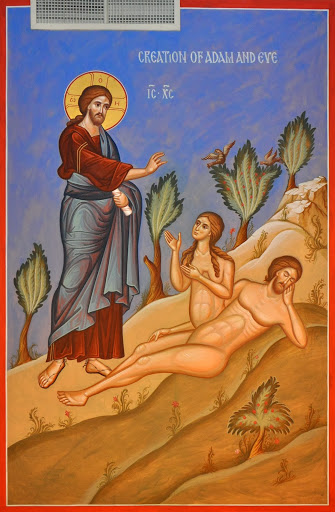
Before we address homosexual marriage it is imperative that we seek to know how the Definer of marriage identifies marriage. We begin in Genesis 2:18-25 18Then the LORD God said, “It is not good for the man to be alone; I will make him a helper suitable for him.” 19Out of the ground the LORD God formed every beast of the field and every bird of the sky, and brought them to the man to see what he would call them; and whatever the man called a living creature, that was its name. 20The man gave names to all the cattle, and to the birds of the sky, and to every beast of the field, but for Adam there was not found a helper suitable for him. 21So the LORD God caused a deep sleep to fall upon the man, and he slept; then He took one of his ribs and closed up the flesh at that place. 22The LORD God fashioned into a woman the rib which He had taken from the man, and brought her to the man. 23The man said, “This is now bone of my bones, And flesh of my flesh; She shall be called Woman, Because she was taken out of Man.” 24For this reason a man shall leave his father and his mother, and be joined to his wife; and they shall become one flesh. 25And the man and his wife were both naked and were not ashamed.

God is the one who said that it was not good for man to be alone. So when He created a helper for man He created a woman — not another man. God established monogamy as the pattern for marriage. From Genesis 1:1 1In the beginning God…. We know that the universe is not a chance happening. God is intimately involved with our existence. God putting His stamp on creation in a unique way creates man. Genesis 1:26-28 26Then God said, let Us make man in Our image, according to Our likeness; and let them rule over the fish of the sea and over the birds of the sky and over the cattle and over all the earth, and over every creeping thing that creeps on the earth. 27And God created man in His own image, in the image of God He created him; male and female He created them. 28And God blessed them, and God said to them, “Be fruitful and multiply, and fill the earth, and subdue it; and rule over the fish of the sea and over the birds of the sky and over every living thing that moves on the earth.4

Man is created to have dominion over the earth. Before family comes purpose. The purpose was that mankind would have dominion. Remember, the fall of man has not occurred, yet. Man is still in a perfect environment. Genesis 1:31 And God saw all that He had made, and behold, it was very good. When God created man, He created the capstone of His creation whose job it is to run His creation.

In Genesis 2:18 the woman comes on to the scene. 18Then the Lord God said, it is not good for man to be alone, I will make him a helper suitable for him. Woman was conceived in the mind of God not Adam’s. Please note that this is different than the creation of male and female animals. Male and female animals were all created at the same time. The first creation of man and woman occurred at different times. I believe the reason why this happened is because male and female human beings were given the responsibility of dominion. Animals were not. Whenever you delegate dominion you necessarily have hierarchy.

Genesis 2:21 21So the LORD God caused a deep sleep to fall upon the man, and he slept; then He took one of his ribs and closed up the flesh at that place. Eve is created out of Adam. So Adam is only half the man he used to be because he loses one side. In order for him to become a whole man he has to get his rib back. But his rib is now located in somebody else. He can’t take the rib out of somebody else and put it back. So in order to get his rib back he has to take hold of somebody else’s life, and make this somebody part of his life to get the rib back that he lost. But getting his rib back means he gets another half he didn’t count on, because he not only gets his rib, he gets her rib, too.

That means, gentlemen, that what marriage does is bring back what you lost, with a bonus. That is why she is different from you. And, that means, ladies, if you are going to understand your rib, you have got to understand Adam because half of your ribs belong to him. So in order for you to understand who you are, in the marriage relationship, you need to understand who he is, because half of what makes you you, is part of what makes him him. So in order for both of you to become all that both of you were meant to be, both of you have to merge into each other. If you don’t take from your mate their strengths you do not become all you were created to be.

God performs the marriage ceremony and Adam says Genesis 2:23 23This is now (he doesn’t say “she” is now) he says “This is now” meaning this new relationship, he is talking about marriage. This is now bone of my bone, flesh of my flesh, she shall be called woman because she was taken from man. Adam names her. He names her after himself. His name in Hebrew is Eish. The Hebrew word for woman is Eisha. In the first marriage, she takes his name. All Eve knows when she is created is that she is there. She doesn’t know who she fully is until she receives his name. That is why in marriage there is a transfer of names from the woman’s last name to the man’s last name, because she is now merged into another purpose.

There are at least six purposes for which God create marriage and family. The first reason for marriage is procreation: having babies. The Bible makes grand statements about having babies, the more the merrier. Why the big deal? Remember God told Adam and Eve to be fruitful and multiply so that you will have dominion over the earth, the reason was not just to have people that looked like them, it had to do with the theology of dominion. Dominion meant to reproduce yourself and spread out all over the earth, so that all over this planet there would be somebody ruling under God’s authority. Mankind cannot perpetuate itself based on homosexual marriage.

Secondly, marriage is self-realization. “Adam I will make a helpmate for you.” As long as you are single, God is your completeness. When it is time to marry, God is in the process of bringing someone along to fix up the rest of us to make us complete. The reason Adam was given a wife was to complete him. God doesn’t give you somebody just like you. For if both of you are the same, then one of you would be unnecessary. He gives someone who is different from you so that you can make up the differences, so that you can fulfill the complete purpose of God that He has ordained.

Thirdly, marriage is a divine Illustration. You are a type of Christ in the church. The Bible says that you are the bride and Christ is the bridegroom. You are to illustrate a greater reality of God to His people. So a bad marriage means a bad illustration. Ephesians 5:32 tells us that this is an illustration of the relationship of Christ. Homosexual marriage is not a reflection of divine illustration. In fact, one could make an argument that it borderlines on blasphemy.

Fourthly, marriage brings about companionship. God created marriage for companionship. Genesis 2:18 Then the Lord God said, “It is not good for the man to be alone.” There is a great blessing in sharing life with the one you love — your companion. God created Adam and Eve when He declared that it was not good for man to be alone.

Fifthly, marriage brings enjoyment. God created sex for enjoyment, in the context of marriage. I Corinthians 7:5 Stop depriving one another, except by agreement for a time, so that you may devote yourselves to prayer, and come together again so that Satan will not tempt you because of your lack of self-control. Outside of the context of heterosexual marriage there might be “pleasure for a season,” (Hebrews 11:25) but there can be no true, lasting enjoyment.

Sixthly, marriage is for protection. God desires a godly seed. Malachi 2:15 15But not one has done so who has a remnant of the Spirit. And what did that one do while he was seeking a godly offspring? Take heed then to your spirit, and let no one deal treacherously against the wife of your youth. God knows that marriage provides protection for the family.

But we now live in a lost and fallen world. And America is not exempt from this broken world. In fact, there are many reasons to believe that America, far from being an example for the nations, is now leading the nations in the wrong direction. A recent article on systemic corruption in America is an eye-opening compendium of the near complete fallenness of government, corporations, and the people.

The Book of Romans gives us a description of the end-times society when Jesus will return and God will pour out His wrath, beginning with Chapter 1. 21For even though they knew God, they did not honor Him as God, or give thanks; but they became futile in their speculations and their foolish hearts were darkened. 22Professing to be wise they became fools. I have seen men with degrees, piled on top of degrees that get up and say how you and I evolved from monkeys. Maybe they did, but I sure didn’t! Some of the greatest intellectual minds of the universe talk about how we evolved from a single cell protoplasmic blob! That is beyond the comprehension of the mind. If you saw a Boeing 747 flying across the sky, wouldn’t you assume that because it could fly, it can carry people, its seats are placed in rows, and that it can do all the things it can do; wouldn’t you assume that somebody thought it up, and somebody put it together? Certainly you would not conclude that it was the accidental product of a tornado blowing through a junkyard. Yet, the same mind can look in the sky and see a bird fly by and say, “product of chance.”

23And they exchanged the glory of the incorruptible God for an image in the form of corruptible man and of birds and four-footed animals and crawling creatures. They worshiped the creature rather than the Creator. We have the worship of the creature going on around us on a global scale. Then look what happened — here is the tragic payoff. 24Therefore God gave them over in the lust of their hearts to impurity, that their bodies might be dishonored among them. 25For they exchanged the truth of God for a lie, and worshiped and served the creature rather than the Creator, who is blessed forever, Amen. Now look what God did, because they worshiped the creature rather than the Creator, God steps back. It is as if God has parameters, or limits, as to how far evil can go. He says that evil can only go so far. But, God says if you are going to knock against those limits, and if you knock against them long enough I am going to step back. I will let you foul your own nest and if you want to live like a pagan, you can. When He steps back what happened? There was an outbreak of immorality. Does that sound familiar?

26For this reason God gave them over to degrading passions; for their women exchanged the natural function for that which is unnatural, 27and in the same way the men abandoned that natural function of the woman and burned in their desire towards one another, men committing indecent acts and receiving in their own person the due penalty of their error.5 God says if you are going to live like that I am going to step back. What happens? An outbreak of sexual immorality begins. It culminates in an outbreak of homosexuality. We are there! We have arrived!

28And just as they did not see fit to acknowledge God any longer, God gave them over to a depraved mind, to do those things which are not proper. When God steps back there is an outbreak of immorality. When we continue to push up against those limits God will step back again, and there is an outbreak of homosexuality. When we continue to push those limits, God steps back again and turns us over to a depraved mind, to do those things which are not proper. It is a time when lawlessness begins to rule and mankind does not have any standards by which they live by. Paul finishes the chapter by listing signs of depravity.

29being filled with all unrighteousness, wickedness, greed, evil; full of envy, murder, strife, deceit, malice; they are gossips, 30slanderers, haters of God, insolent, arrogant, boastful, inventors of evil, disobedient to parents, 31without understanding, untrustworthy, unloving, unmerciful; 32and although they know the ordinance of God, that those who practice such things are worthy of death, they not only do the same, but also give hearty approval to those who practice them. With all the attention given to homosexuality in the media, it is no wonder that Gallup recently found that the American public estimates that 23 percent of Americans are gay or lesbian, while the actual number Gallup finds to be 3.8 percent. And the Williams Institute finds a total of 390,000 married same-sex couples. However, regardless of the number of homosexuals in America, the definition of marriage is not decided by plebiscite. God has defined marriage as between one man and one woman. If a man and a man or a woman and a woman desire to be together, that is not marriage. Marriage has been defined from the beginning, by the One who created us male and female.

Most people know the story of Jonah: he was a prophet whom God told to go to Nineveh and preach a message of repentance. Nineveh was the capitol of Assyria which was located 550 miles Northeast of Israel. But Jonah decides he would go to Tarshish, which was 2,500 miles to the Northwest. Jonah is a renegade preacher who does not want to do what God called him to do. In his rebellion, he is tossed overboard of a ship and is swallowed by a big fish. He was there three days and three nights and was regurgitated on to dry land.

After Jonah goes on the first submarine ride in history, he agrees to do what God asked him to do. Jonah goes to Nineveh and preaches to the city, and in one day the entire city repents. Jonah 3:5-9 5Then the people of Nineveh believed in God; and they called a fast and put on sackcloth from the greatest to the least of them. 6When the word reached the king of Nineveh, he arose from his throne, laid aside his robe from him, covered himself with sackcloth and sat on the ashes. 7He issued a proclamation and it said, “In Nineveh by the decree of the king and his nobles: Do not let man, beast, herd, or flocks taste a thing. Do not let them eat or drink water. 8“But both man and beast must be covered with sackcloth; and let men call on God earnestly that each may turn from his wicked way and from the violence which is in his hands. 9“Who knows, God may turn and relent and withdraw His burning anger so that we will not perish.”

Notice this about the people of Nineveh. Conversion changed the political environment of Nineveh. It didn’t happen because they made better laws, hired more policemen, or provided more arms for the people to reduce the violence. The violence was removed because the people met a living God. The thing that changes people and brings about peace to an environment is when men repent before a living God. Nineveh still had the same King, the same Congress, the same Supreme Court, and the same city Council. The difference now was there was a heart transformation and that translated into actions and behavior. That is the only thing that will help America change. When the people of America, leaders of America, and Supreme Court Justices of America encounter the Living God who has the power to forgive, and to transform our hearts, then we will see a new America. It doesn’t matter who is in public office; it matters if their hearts are committed to the Living God.

________________________________

Dr. James Taylor, Senior Pastor at Christ’s Church of Norman in Norman, Oklahoma. http://www.ccnonline.biz. He is the author of the forthcoming book “It’s Biblical, Not Political: How to Line Candidates up Biblically.”

This article is part of a series on “Building Resistance to Same-Sex Marriage.” Should you want to help support this important work, contributions may be made to the U.S. Justice Foundation.

Permission is freely granted to publish, copy, reproduce, distribute, or excerpt from this article for any purpose.

Posted in Uncategorized | Leave a comment

The Fourteenth Amendment Does Not Mandate Same-Sex Marriage

Building the Resistance to Same-Sex Marriage

(Part two of a series)

The Fourteenth Amendment Does Not Mandate Same-Sex Marriage
By Herbert W. Titus and William J. Olson

1a7d325ed34b774e9f14e057333e6949Within the month, the nation will receive the opinion of the U.S. Supreme Court as to whether the U.S. Constitution requires all of the states to jettison their domestic laws and sanction same-sex marriage. Numerous federal judges have so ruled, and most states have simply yielded to those federal court decisions. In a few cases, beginning with Vermont and Massachusetts, state courts ruled for same sex marriage, and state officials have accepted passively those decisions as well.

Generally, courts have ruled for same-sex marriage using either the “due process clause” or the “equal protection clause” of the Fourteenth Amendment, or both. That raises a simple question: is it really possible that when the Fourteenth Amendment was ratified in 1868 the framers intended that it sanction same-sex marriage? Of course not. The U.S. Constitution says nothing about same-sex marriage. Then, how could the Constitution be manipulated to support a decision in favor of same-sex marriage? Well it has not been easy. The Constitutional case for same-sex marriage is pathetically weak — unless you adopt the notion of an “evolving” Constitution — which is, of course, the polar opposite of the notion of our “written” Constitution.

There are actually four cases, all from the U.S. Court of Appeals for the Sixth Circuit, which have been consolidated for decision in the U.S. Supreme Court — Obergefell, DeBoer, Tanco, and Bourke. If you would like to know more about how this case developed, a great deal of information, and links to all documents, is available on SCOTUSblog. The amicus curiae brief which we filed in the Sixth Circuit in support of traditional marriage is available, as is the amicus curiae brief which we filed in the U.S. Supreme Court.

The opinion by Judge Sutton of the U.S. Court of Appeals for the Sixth Circuit — upholding traditional marriage against five challenges in four states — begins with a remarkable observation that should have resolved the case in that once sentence, but did not. Judge Sutton points out that “[n]obody in this case … argues that the people who adopted the Fourteenth Amendment understood it to require the States to change the definition of marriage.” DeBoer v. Snyder, 772 F.3d 388, 403 (6th Cir. 2014) (emphasis added).

Laymen logically deduce that if the Fourteenth Amendment as written had nothing to do with same-sex marriage, that’s the end of the matter. After all, Justice Douglas succinctly described the Amendment in his autobiography: “The Fourteenth Amendment was passed to give blacks first-class citizenship.” William O. Douglas, The Court Years, p. 154 (Random House: 1980). But for those lawyers who want unelected judges to set the public policy of our nation, it simply doesn’t matter what the Framers intended. And neither does it matter to many judges who are all too willing to give effect to their own political views. Discovering the “authorial intent” of the Framers is only a small part of their concern — a step they sometimes skip over entirely.

Recently, Justice Alito observed that “[s]ame-sex marriage presents a highly emotional … question … but not a difficult question of constitutional law.” United States v. Windsor, 570 U.S. ___, 133 S.Ct. 2675, 2714 (2013) (Alito, J., dissenting):

The Constitution does not guarantee the right to enter into a same-sex marriage. Indeed, no provision of the Constitution speaks to the issue. It is beyond dispute that the right to same-sex marriage is not deeply rooted in this Nation’s history and tradition. [Id. at 2714-15.]

Therefore, Justice Alito explained that challengers to traditional marriage:

seek … not the protection of a deeply rooted right but the recognition of a very new right, and they seek this innovation not from a legislative body elected by the people, but from unelected judges. [Id. at 2715.]

If we are now considering a new right, one could legitimately ask when and where did this new right come from. Indeed, during oral argument in the case of Hollingsworth v. Perry, Justice Scalia asked this very question to same-sex marriage champion lawyer Ted Olson:

Justice Scalia: “When did it become unconstitutional to prohibit gays from marrying?… Was it always unconstitutional?”

Ted Olson: “It was [un]constitutional when we — as a culture determined that sexual orientation is a characteristic of individuals that they cannot control…”

Justice Scalia: “I see. When did that happen?…”

Ted Olson: “There’s no specific date in time. This is an evolutionary cycle.”

Of course, a written constitution that is subject to evolutionary change is no longer a written constitution. A constitution that is always evolving provides no fixed guarantees for the rights of the people. If the “Due Process Clause” of the Fourteenth Amendment can morph into a mandate for homosexual marriage, then the “right to keep and bear arms” can become a right to call the police when attacked. Once we abandon the author’s meaning of a text, we are left treating the U.S. Constitution as poetry, asking “what does the Constitution mean to me?”

Unable to ground their challenge in the Fourteenth Amendment as written, the advocates of same-sex marriage have used an assemblage of fabrications, purportedly derived from this Court’s precedents, but without any support in fact or law.

One of the briefs in the Supreme Court asserted that the High Court has already established that “[t]he right to marry the person of one’s choice is a fundamental freedom.” The claim is patently false.

To the contrary, the Supreme Court has always assumed that marriage law was originally governed by the common law which required consummation between one male and one female. See Maynard v. Hill, 125 U.S. 190, 213 (1888). See also 1 William Blackstone, Commentaries on the Laws of England, 424 (Univ. Of Chi. Facsimile ed.: 1765).

The Court in Maynard explained: “though formed by contract … the relation of husband and wife, deriv[ed] both its rights and duties from a source higher than any contract of which the parties are capable, and, as to these, uncontrollable by any contract which they can make.” And “[w]hen formed,” the Court continued, the relation between husband and wife was “no more a contract than ‘fatherhood’ or ‘sonship’ is a contract.” Instead, marriage “partakes more of the character of an institution regulated and controlled by public authority, upon principles of public policy, for the benefit of the community.” Thus, it is just pretense to claim that the Supreme Court previously established the right “to marry the person of one’s choice.”

Any such claim is a total fabrication designed to hide the fact that at the time the nation was founded not only was same-sex marriage not legally sanctioned, but sexual relations between men constituted, as Sir William Blackstone declared, “the infamous crime against nature[,] a disgrace to human nature,” and punishable by death. 4 Blackstone’s Commentaries at 215-16.

In addition to this condemnation of “unnatural” sexual coupling, the English common law of marriage exclusively adopted the Biblical matrimonial order. First, the common law limited the relationship to one between “husband and wife,” that is, “baron and feme.” I Blackstone’s Commentaries at 421. And second, the common law made “voidable” any union between a man and a woman under the “canonical disabilities” of “consanguinity, or relation by blood; and affinity, or relation by marriage.” Id. at 422. Thus, it is wildly false for Petitioners to presume, as they have, that there is a well-established right to marry any person of one’s choice.

The same-sex marriage proponents now ask the Supreme Court to take the nation one step further away from our written constitution, by fundamentally changing the meaning of its text based on the will of a bare majority of five lawyers serving on this Court, rather than complying with the exclusive process for amending the Constitution, as set out in its Article V. Freed from textual constraint, Professor Lino Graglia has observed that:

[o]ver the past half-century the justices have chosen to make themselves the final lawmakers on most basic issues of domestic social policy in American society. These include issues literally of life and death … and issues of public morality…. In essence, the Court now performs in the American system of government a role similar to that performed by the Grand Council of Ayatollahs in the Iranian system…. [L. Graglia, “Constitutional Law Without the Constitution: The Supreme Court’s Remaking of America,” in “A Country I Do Not Recognize” (R. Bork ed., Hoover Press 2005).]

Nearly two decades ago, Justice Scalia warned:

[t]his Court has no business imposing upon all Americans the resolution favored by the elite class from which the Members of this institution are selected, pronouncing that “animosity” toward homosexuality … is evil. [Romer v. Evans, 517 U.S. 620, 636 (1996) (Scalia, J., dissenting).]

And, exactly as Justice Scalia predicted in Romer, the American people have seen a flurry of judicial opinions with “no foundation in American constitutional law” overturning laws which were “designed to prevent piecemeal deterioration of the sexual morality” desired by the People. These court opinions together constitute what he described as “acts, not of judicial judgment, but of political will.” Id. at 653.

As such, they are not just “bad law,” but as Blackstone stated, they are “not law” at all.

_____________
William J. Olson served in three positions in the Reagan Administration. Herbert W. Titus taught Constitutional Law for 26 years, and concluded his academic career as the Founding Dean of Regent Law School. Together they have filed over 80 briefs in the U.S. Supreme Court, and scores more in lower courts, addressing important public policy issues. They now practice law together at William J. Olson, P.C. They can be reached at traditionalmarriage@lawandfreedom.com or twitter.com/Olsonlaw.

Permission is freely granted to publish, copy, reproduce, distribute, or excerpt from this article for any purpose.

Posted in Uncategorized | Leave a comment