A Word About “A Mother’s Eyes”

A work of pious fiction which details the earthly life of Our Lord through the eyes of His mother.

Incarnating the Mother of God as more than icon, more than statue, more than pious emotion, author Karen S. Woods treads where few have dared, wrapping the story of Christ and His Mother within our very taste, touch, and feel. It’s a bit unsettling. The struggle for the author was staying true to the story; the difficulty for the reader is allowing the senses to appreciate what the soul already knows. This is Real.

NOTE: Income from the book will be donated to the building fund of St. Raphael Orthodox Mission, Quincy, Illinois.

Order your copy – HERE.

Posted in Uncategorized | Leave a comment

About That Elevator Evangelism …

A while back — HERE — I mentioned the Antiochian Archdiocese’s Department of Missions and Evangelism was sponsoring a contest to see who could write the best 30-second explanation of what the Orthodox Church is, essentially an Orthodox “elevator speech”.

Courtesy of the Department of Missions and Evangelism, here’s the Winner (at top) and some honorable mentions:

The winner, as chosen by plurality in an on-line poll:


Orthodox Christianity is the authentic and original Christian Faith founded by Jesus Christ. As an Orthodox Christian you can experience heaven on earth through the Divine Liturgy which is mystical, spiritual, and beautiful, with it’s incense, icons, and sacred music. You can transcend time and space while you meditate upon the words and teachings of Jesus Christ. It’s the most pure form of Christianity – nothing artificial added. It’s the real deal.

— Valerie Ann Zrake – New York, NY

Orthodox Christians believe that Jesus is the Son of God—who came to earth to heal our brokenness and restore all of us–and all Creation–to our original beauty. He promises that we can be healed of all our brokenness and filled once again with God’s Light and Life and Love—right now—when we follow Him and participate in the wonderful gifts He offers in and through His Church. As we participate in these gifts, God’s Life pours into us—making us more and more like Him—Father, Son and Holy Spirit.

Geri Farman – Austin, TX

It’s pretty simple, really. Orthodox Christianity is nothing more and nothing less than an eternal love affair with God. We love Him so much that we seek to become one with Him, by His grace, and He welcomes us into Himself. It’s not an easy life, being Orthodox. But it has great joys and extreme beauty. Come to Church with me on Sunday and see for yourself.

Karen Woods – Jacksonville, IL

Have you ever been reading the Bible, or hearing about the lives of the martyrs, and wondered, where did that Christianity go? How can I be a part of that now? The good news is that the church of the martyrs, and church of the apostles, and holds to the faith once for all delivered to the saints still exists. That’s the Orthodox Church.

Mark Bradshaw – Decatur, IL

The Orthodox Church is the guard and keeper of the Ancient Faith passed down from the Apostles. She encourages everyone to seek an intimate journey with Christ into the depths of their hearts. Her desire is that all men everywhere would be illumined from within by the Light of Jesus Christ.

Vivian Miles – Bixby, OK

If you go back and look at what the New Testament Church believed and practiced, and look at what the Early Church believed and practiced in the writings of those who were there at the time, you’ll find all that safely preserved, adhered to and practiced in the Orthodox Church. Orthodox Christianity is to experience Christ and become like Him, through the Church and the spiritual training it offers.

Mark Butt – Polson, MT

The Orthodox Church is the original church established by Christ through His disciples. Unlike Western Christianity that now has over 30,000 variations, its beliefs and practices are essentially unchanged from the time of Christ. Since that time, it has been seen as a hospital for broken humanity where God—Father, Son and Holy Spirit—brings his healing Presence to us and restores us to our original beauty—making us more and more like Him.

Geri Farman – Austin, TX

Orthodox Christianity is an ancient faith about love and how we are supposed to manifest Christ’s commandment to love one another through our thoughts and actions. It strips away the notion that Christ is an accountant or a lawyer who is focused on rule-breaking. Instead Orthodoxy focuses on how we show true cosuffering love in our relationships with other people, with the world around us and

with God.

Edward Bottei – Sioux City, IA

Orthodox Christianity is, simply put, the whole of the Christian Gospel. We read about it on the worn pages of our scriptures, we are sobered by it through the blood of our martyrs, we are stirred by it in the lives of our saints and we are transformed by it as the Spirit guides us into all truth. It is the path to deepest worship, the road to the fullest life and the way by which we come to Christ, Who is Himself the Way, the Truth and the Life.

Aaron Jordon – Omaha, NE

So many people are searching for “authentic” church, sensing that something is lacking from their church. When you peel back 2,000 years of history, and look back at what the church was when it all started, you’re looking at the Orthodox Church. It’s remained true to the original pattern of Christianity for 2,000. You should come and see!

Mark Bradshaw – Decatur, IL

Posted in Uncategorized | Leave a comment

AUGUST 9th – St Herman of Alaska

The following pics (click to enlarge) were taken during my visit to Alaska in March of 2006. First, the “Mother Church of North America,” Holy Resurrection Cathedral, Kodiak:

This is the back side of the Cathedral looking toward the water.

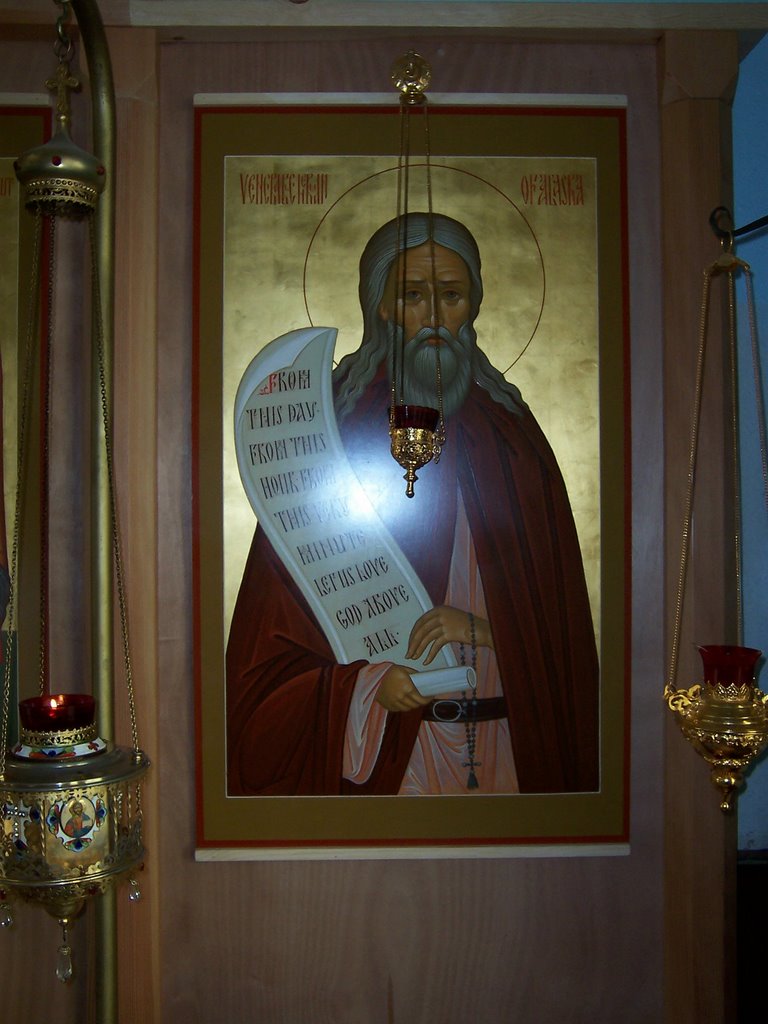
The icon of St Herman which adorns the iconostasis just above his holy relics.

This is where the body of St Herman rests. You can read about St Herman of Alaska … H E R E.

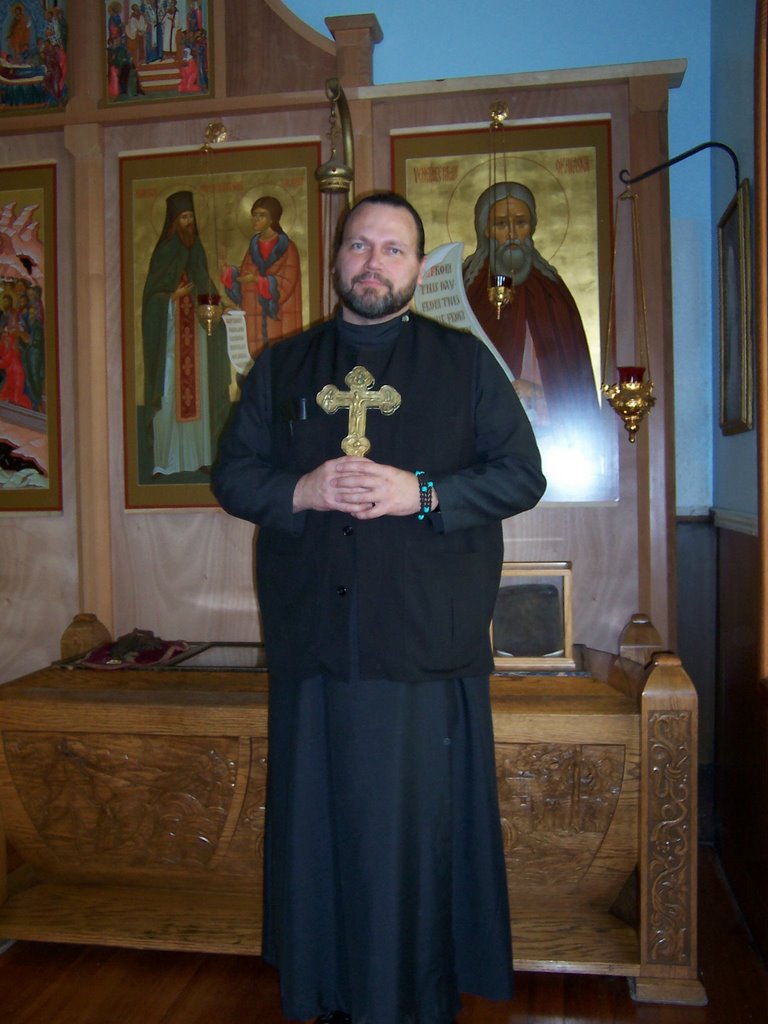
Standing before St Herman’s relics, I’m holding the hand blessing Cross that the Saint used in his reader services.

On March 27, 2006 we were blessed with excellent weather and a relatively calm sea (emphasis on “relatively”) as pilgrimage was made to Monk’s Lagoon, where St Herman struggled, and to St Nilus Island. Here follows some pics of the journey.

Fr Chad Hatfield, then Dean of St Herman’s Seminary, Fr Innocent Dresdow of Holy Resurrection Cathedral, and the skipper of the skiff, Sasha.

The view, looking back toward Kodiak, as we left the harbor.

The view on one side of the boat.

Another view from the skiff.

Headed toward Monk’s Lagoon.

Approaching Monk’s Lagoon. See the monastic building?

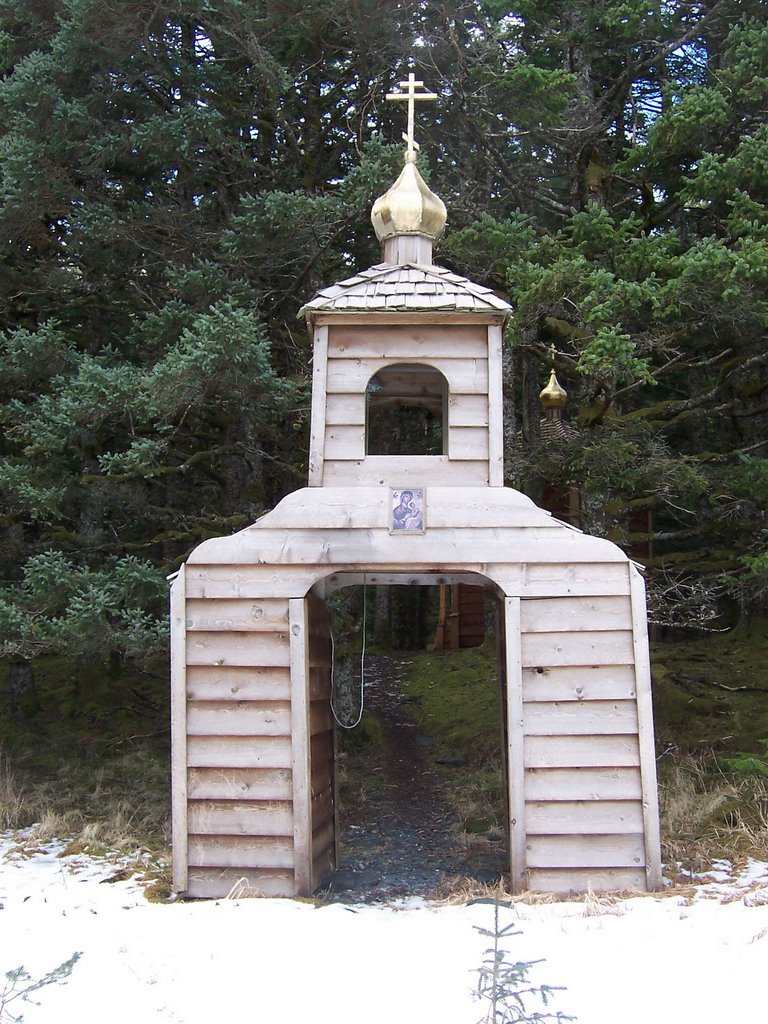
The bell tower from the front entry …

And, looking back toward the sea.


Here’s the beginning of the trail into the forest.

Pilgrims (there were seven of us) making our way into the forest.

The forest.

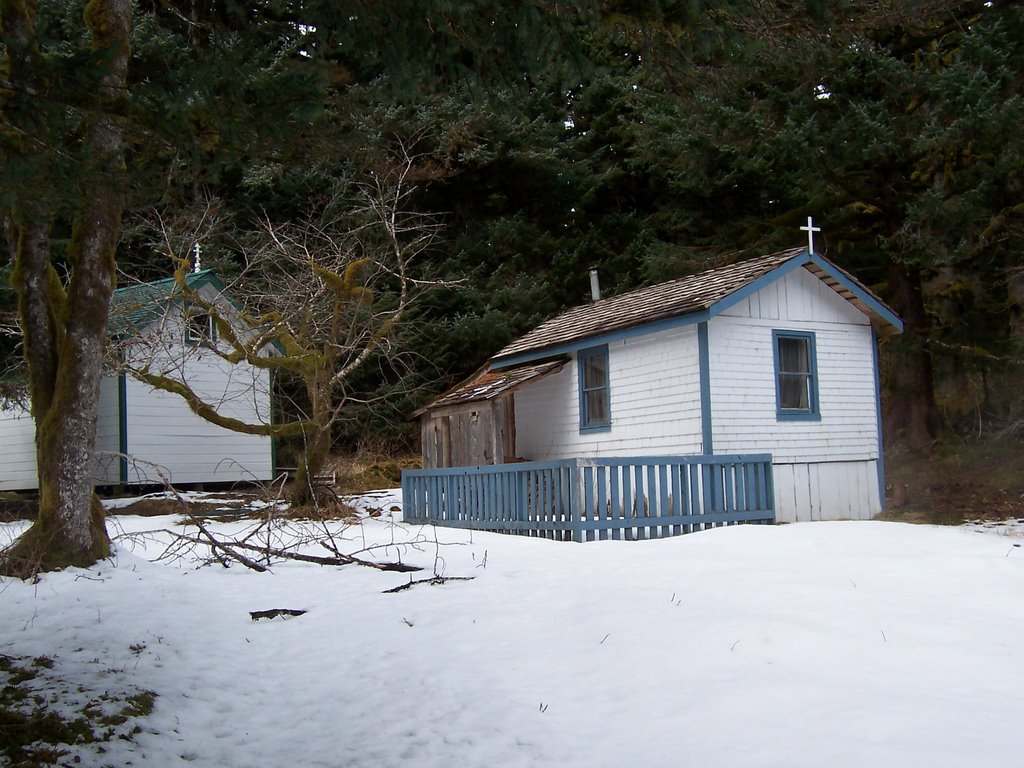
This is the house and chapel of Fr Gerasim Schmoltz. Fr Gerasim lived and struggled here for 40 years, keeping the memory of St Herman alive.

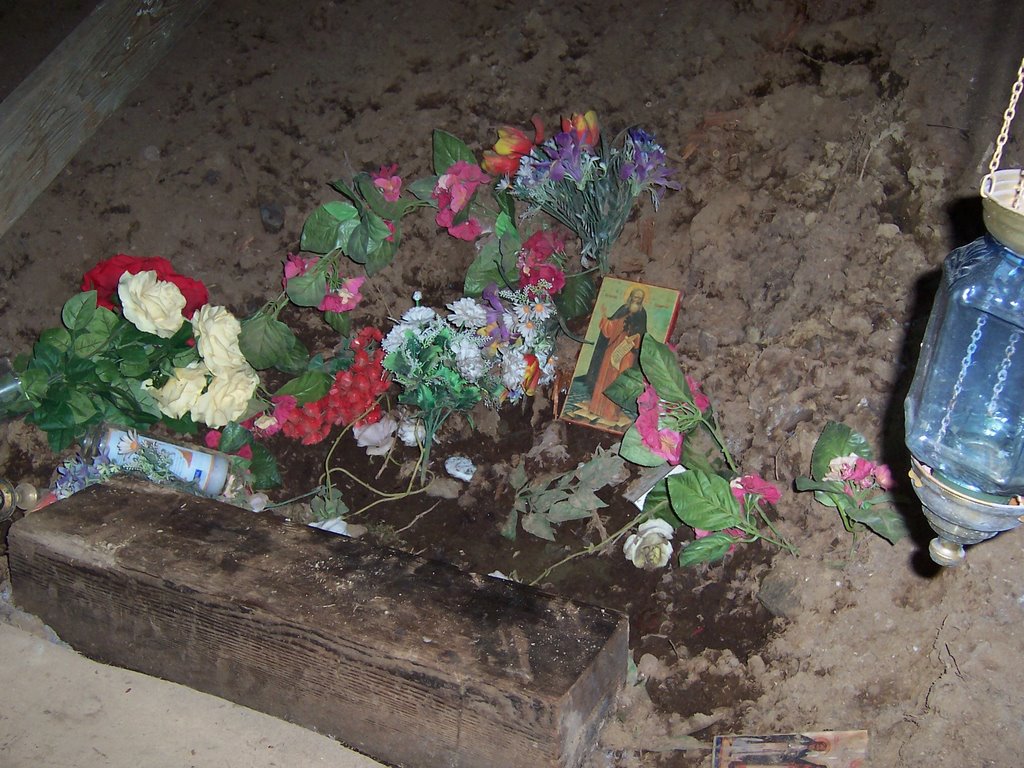
The grave of Father Gerasim.

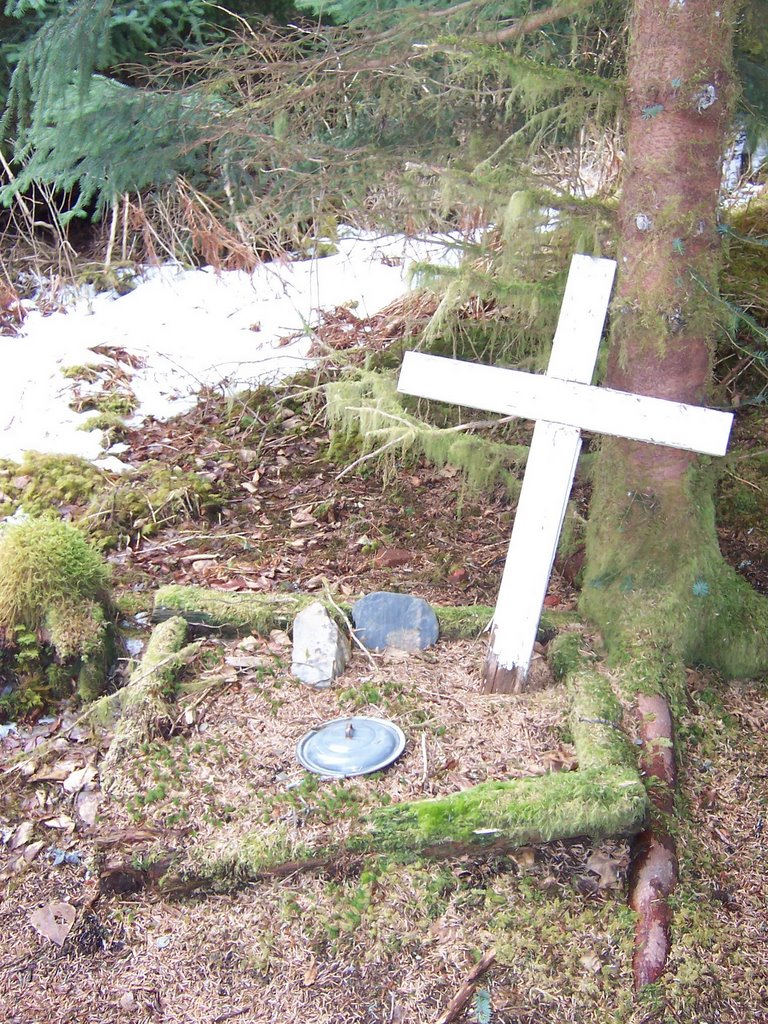
This cross marks the spot where St Herman was originally buried by the orphans (as a priest could not get to the island for 40 days after his death).

Here’s a pic of the forest leading to the Chapel of Saints Herman and Sergius of Valaam. As beautiful as it may seem, pictures just aren’t able to do justice to this amazingly enchanting forest.

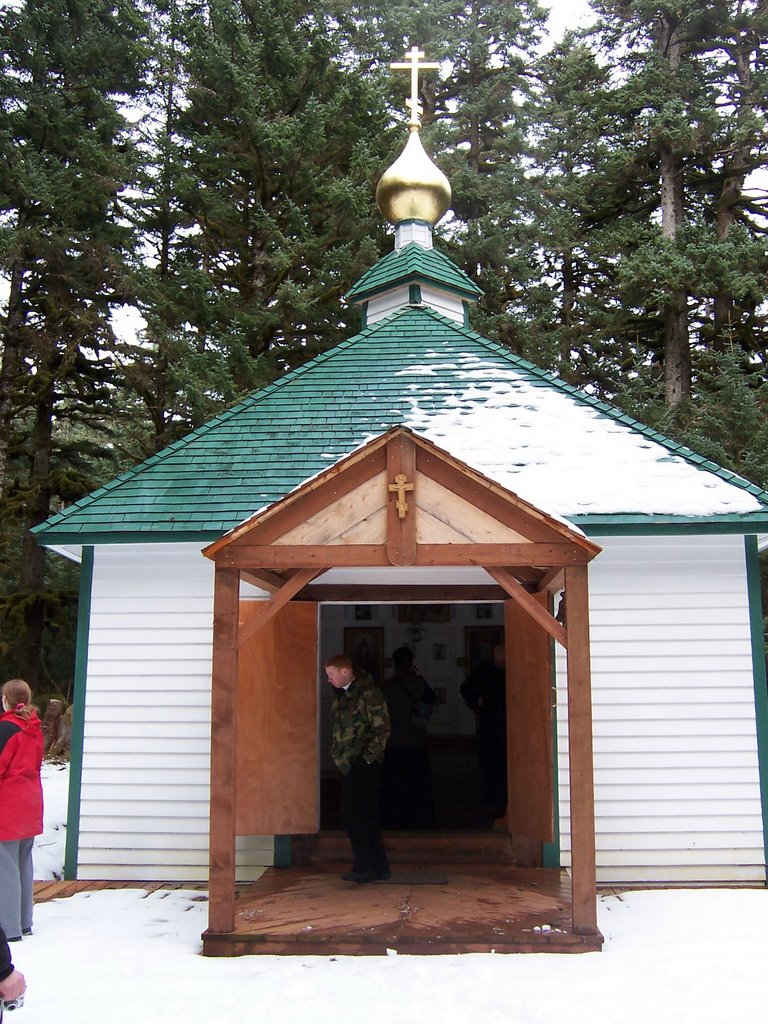
This is Ss Sergius & Herman of Valaam Chapel where the body of St Herman used to rest.

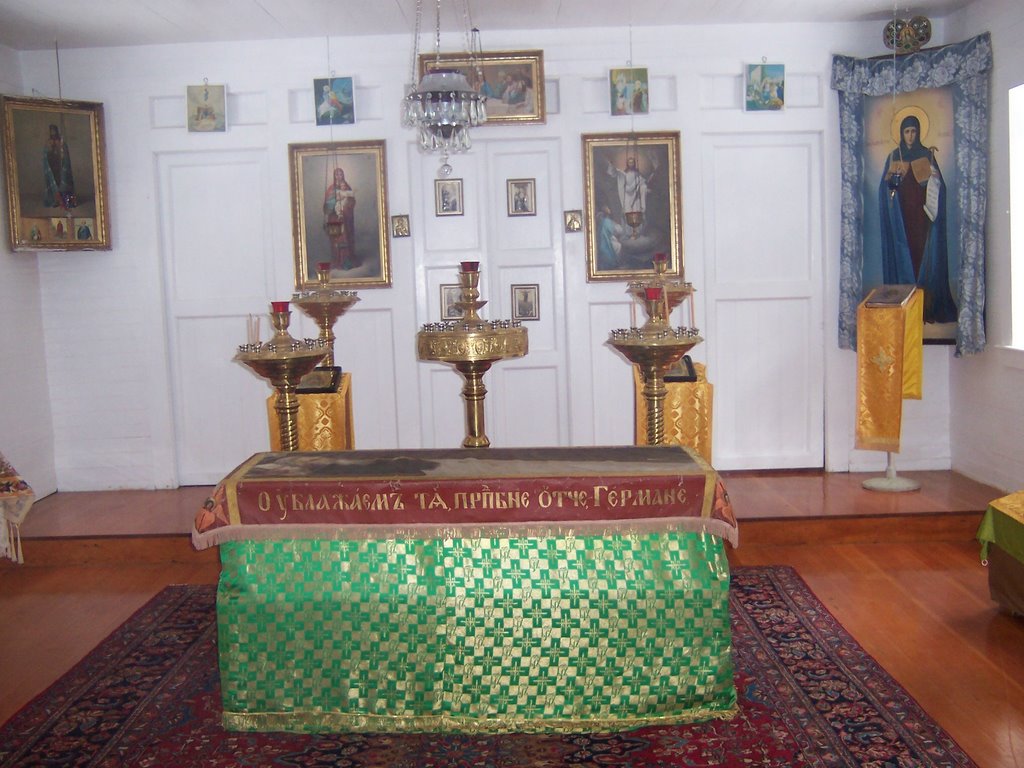
The place where the body, the relics, of the Saint used to lay.

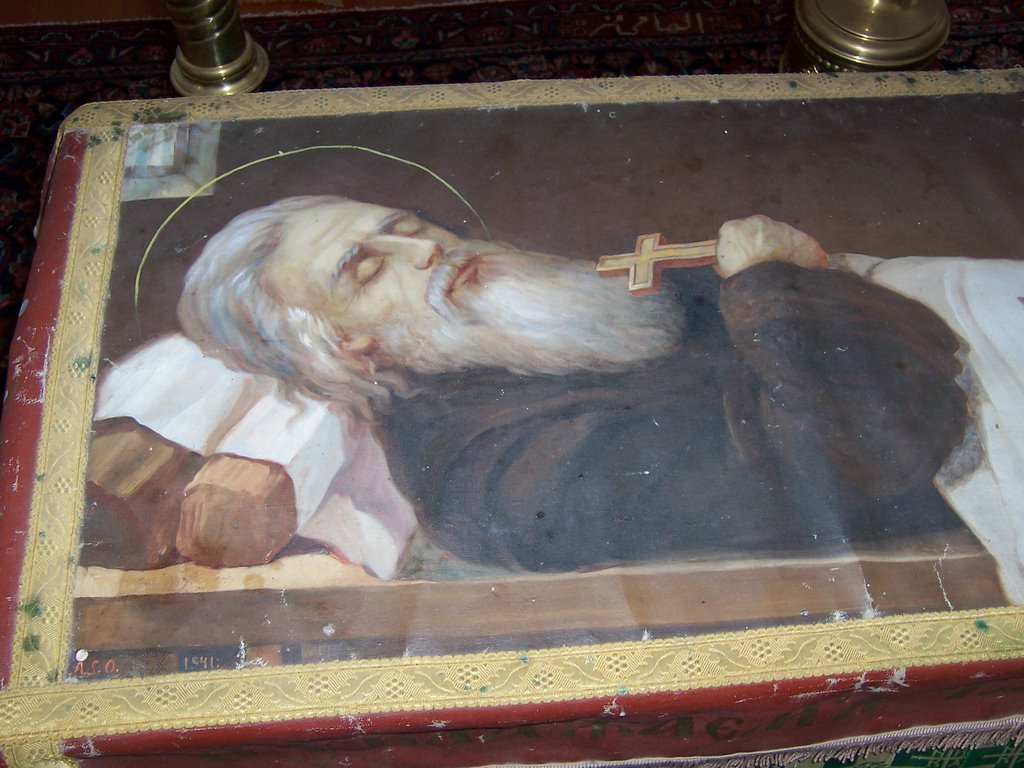
There is now an image [epitaphios] of St Herman at the former resting place.

Prior to being moved upstairs into the chapel, St Herman’s holy body had been buried under the chapel. In other words, the chapel was built over his grave (which, as mentioned in an earlier post, was the Saint’s second interment). Today, you can crawl under the building into the small crawl space and reverence the holy spot and, obviously, take a picture. As also mentioned in a previous posting, St Herman’s relics are currently enshrined at Holy Resurrection Cathedral in Kodiak. Someday, when there’s a sufficient monastic presence and a secure structure, his body will return to Spruce Island and the Ss Sergius & Herman of Valaam Chapel.

Pilgrims returning to the shore …

and waiting for the skiff.

Monk’s Rock, out in the midst of the ocean, where St Herman would often go for “retreat.”

A closer view of Monk’s Rock. See the two eagles sitting up top?

Monk’s Rock in the “rear view mirror.”


NOTE: On March 11, 1969, the Great Synod of Bishops of the Orthodox Church in America (OCA) solemnly proclaimed the Act of the Universal Church Canonization of the Staretz Herman to Sainthood in the Orthodox Church in America: “Taking into consideration the long and undisputed witness of the grace of God, appearing through the servant of God, the Staretz Herman of Alaska.” Saint Herman was the first saint from America to be canonized by the Orthodox Church. The glorification of Father Herman was performed on August 9, 1970, at Holy Resurrection Cathedral in Kodiak, Alaska by the OCA with parallel services at the Synodal Cathedral of Our Lady, Joy of all who Sorrow in San Francisco by the Russian Orthodox Church Outside Russia (ROCOR). His relics were transferred from his grave underneath the church of Saints Sergius and Herman of Valaam Chapel on Spruce Island to the Holy Resurrection Cathedral in Kodiak. Source

Posted in Uncategorized | Leave a comment

I’m Not Gay; I Was Drawn This Way!

Recently, at Church Camp, it became clear, especially in the “Ask Abouna” sessions, that young people have questions about sexuality. Nothing new here, I suppose it has always been; but just not so poignant (or pornographic) – but more on that in part two of this two-part series.

Usually on this podcast, I attempt to be funny. Which is not to say gay; I mean, who wants to be gay, right? Aren’t you born that way? Well, I can tell ya one thing: You’re not born funny! You have to work at it. But, if you’ll forgive me, I will pass on the humor this week and say:

When you are a priest at camp and a 10-year old girl says, in a group setting, ‘My best friend is gay’ … well, ain’t nuthin funny ‘bout that.

I wanted to scream WE’RE ALL GAY WHEN WE’RE TEN!

Which, of course, is true (on many levels). When I was ten, there were the Flintstones whose cartoon theme song encouraged us all to ‘have a gay old time’.

I ask you – and, for those who are angry about their so-called sexuality, this is a rhetorical question:

HOW ARE YOU GAY when you are TEN?

Where does one even get such a notion? Why was it on the minds of the Teens and Tweens more this summer at Camp than, seemingly, in the past?

The answer to that is simple: Our young people are fed a steady diet of Sexy Soup daily, constantly – not only on the internet and television … but, these days, in the public school system.

What. An. Idea.

Speaking of which, let’s look at …

The Orthodixie Podcast on Ancient Faith Radio.

Image Source

Posted in Uncategorized | Leave a comment

TRANSFIGURATION: Why Bless Grapes?

At the conclusion of the Divine Liturgy on the Great Feast of the Transfiguration of our Lord on Mount Tabor, the priest blesses grapes …

Why?

Here follows some answers …

The blessing of grapes, as well as other fruits and vegetables on this day is the most beautiful and adequate sign of the final transfiguration of all things in Christ. It signifies the ultimate flowering and fruitfulness of all creation in the paradise of God’s unending Kingdom of Life where all will he transformed by the glory of the Lord.
Source

This is an ancient Christian custom. The first week of August, on the sixth of August, the farmers use to gather the early fruits of their summer harvest (grapes, figs etc.) and to present them in the Church to be blessed and to give them for free to congregation. These fruits are called the “beginnings”.

In a text from the 7th century (“the laws of the kingdom” by emperor Constantine Porfirogenitos) this custom is described vividly: “The Emperor of Constantinople gathers the “beginnings” (“aparches”) in Chalcedone, where there are many vines, and then he waits for the Patriarch of Constantinople to come on the the Holiday of Transfiguration, to bless the fruits and to personally hand out the grapes to the laymen”.

This custom is honored in many places in Greece where there are plantation with vines.

We must not forget that the Church was presented once as a “vine”. So, [the] Church blesses the first fruits of vine giving a “theological” meaning to farmer’s work.
Source

In footnote 2 for Canon III of the Canons of the Apostles it says that, “during the festival of the Dormition…they used to offer bunches of grapes to the patriarch…at the end of the divine service. Today however [this is St Nikodemos Agiorite writing in the early 19th c] it is the prevailing custom in most regions for such grapes to be offered at the festival of the Transfiguration of the Saviour, and for them to be offered by the priest.”
Source

A nun, Mother Evfrosinia adds …

However, as grapes do not ripen at the same time everywhere, the Church adapted this tradition in various ways. In some places in the Holy Land, for instance, grapes are blessed on the feast of the prophet Elijah. In Russia, where grapes were not always readily available, apples were more commonly blessed, and Transfiguration is known as “Yablochny Spas”, “the Apple Feast of the Saviour”. In northern Russia, where even apples weren’t ripe by August 6/19, it was traditional to bless peas. Nowadays, when you can buy any sort of fruit or vegetable year round, we’ve lost the sense of getting a blessing to partake of the first fruits. But we can still try to keep to the spirit of this tradition. In our monastery we bless all sorts of fruit on Transfiguration, but we abstain only from grapes, taking care not to eat grapes of the new harvest until the feast, in keeping with the ancient monastic practise.
Source

In addition, the blessing of grapes, that is specifically mentioned liturgically, is an allusion to the Mystery of the Holy Eucharist, the New Wine that is Christ’s Blood that nourishes us spiritually. The liturgical prayers also refer to Christ Himself as the “Divine Cluster” attached to the Cross from which “Drips the Mystic Wine.”
Source

Some ancient Typicons prescribe the blessing of fruit of the vine (grapes), not on the feast of the Transfiguration, but on the feast of the Dormition. In the Greek Nicolo-Casulan Typicon of the twelfth-thirteenth century, we read: “Let it be known that, on the feast of the Dormition of the Most Holy Mother of God, the 15th of August, grapes are blessed and eaten in church after the Divine Liturgy according to an ancient tradition.” The Typicon of Sinai of the year 1214 contains the same prescription. Similarly, the Typicons of the Lavra of St. Athanasius on Athos prescribes the blessing of grapes on the 15th of August. We have the custom of blessing flowers on the feast of the Dormition.
Source

Finally, the late Bishop Alexander

It is the tradition of the Day of Transfiguration to consecrate grapes, apples and other fruit after the Divine Liturgy. The custom of bringing fruit to the temple for consecration originates in the Old Testament time (Gen 4:2-4; Ex 13:12-13; Num 15:19-21; Deut 8:10-14). The Apostles brought this tradition to the Church of the New Testament (1 Cor 16:1-2). Instruction regarding bringing fruit to temple is found in the Third Rule of the Apostolic Canon, the earliest collection of ecclesiastic laws (canons), known since the second century. In Greece, August is the month of ripeness of fruit, mostly grapes and new ears of corn. Since old time, the faithful have been bringing them to temple for consecration and as Thanksgiving to God. St. John Chrysostom wrote, “Plowman receives fruit from the earth not so much for his labour and diligence, as out of goodness of God Who grows this fruit, because neither is he that planteth any thing, neither he that watereth; but God that giveth the increase.”

Grapes are brought to temple because they are directly related to the Eucharistic sacrament; that is why in the prayer for consecration of grapes the priest says, “Bless, Lord, this new fruit of vine which reached ripeness because Thou kindly provided good weather, drops of rain and stillness. Let eating this fruit of vine make us joyful. And give us the honor of offering this fruit to Thee, as the gift of purging of sins, altogether with the Holy Body of Thy Christ.”

In the first centuries of Christianity, the faithful brought forth to the temple the fruit and crops of the new harvest: bread, wine, oil, incense, wax, honey etc. Of all these offerings, only bread, wine, incense, oil and wax were taken to the altar, while the rest was used for the needs of the clergy and the poor whom the church was caring for. These offerings were to express gratitude to God for all goods, but at the same time help servants of God and people in need. Until today, consecration of bread and wine, eggs and milk and other food has been kept in consecration of artos in the church and meals at home on Easter. Consecration of flowers and tree branches is performed now on Palm Sunday, the days of the Holy Trinity and Exaltation of the Cross, and on Sunday of the week of the Veneration of the Cross. Rice with rasins and honey are used as offerings in services for the dead and remembrance repast. Prosphoros are brought forth for proskomide everywhere even today.
Source

Originally posted in 2006; some links may be broken.

Posted in Uncategorized | Leave a comment