Arrivederci & A presto?

FYI, the following is a listing of the Orthodox delegation at the funeral of Pope John Paul II. While it is in Italian, it should be easily understandable to all:

DELEGAZIONI RELIGIOSE CHE HANNO ANNUNCIATO LA LORO PRESENZA ALLA MESSA ESEQUIALE DI SUA SANTITA GIOVANNI PAOLO II

1 – CHIESE ORTODOSSE PATRIARCATO ECUMENICO
Sua Santita Bartolomeo I
Arcivescovo di Costantinopoli
Patriarca ecumenico
Sua Eminenza Gennadios
Arcivescovo d’Italia – Esarca per l’Europa Orientale
[del Patriarcato ecumenico]
Sua Eminenza Cyril
Metropolita di Imbros
Sua Eminenza Johannis
Metropolita di Pergamo
Rev.do Diacono Dositheos Anagnostopoulos
[Sig. Nicholas Manginas, fotografo]
2- PATRIARCATO GRECO ORTODOSSO D’ALESSANDRIA E DI TUTTA L’AFRICA
S.E. Petros
Metropolita d’Axoum
3 – PATRIARCATO GRECO ORTODOSSO DI GERUSALEMME
Archimandrita Theoktistos
Esarca del Patriarcato di Gerusalemme ad Atene
Prof. Spyridon Kontoyannis
Docente dell’Universita di Atene
4 – PATRIARCATO DI MOSCA
S.E. Kirill
Metropolita di Smolensk e Kaliningrad
Presidente del Dipartimento per le Relazioni Ecclesiastiche Estere del
Patriarcato
Rev. Igor Vyzhanov
Facente Funzione di Segretario per le Relazioni con la Chiesa Cattolica del
Dipartimento per le Relazioni Ecclesiastiche Estere del Patriarcato
5 – CHIESA ORTODOSSA UCRAINA (PATRIARCATO DI MOSCA)
S.E. Mitrofan
Arcivescovo di Pereiaslav-Khmelnitsky
Incaricato per gli Affari della Chiesa Ortodossa Ucraina (Patriarcato di
Mosca)
6 – CHIESA ORTODOSSA DI GEORGIA
S.E. Daniel [Datuashvili]
Metropolita di Tskhum-Abkhazia
S.E. Gerasime [Sharashenidze]
Vescovo di Zugdidi e Tsaishi
Incaricato per le Relazioni interecclesiali della Chiesa ortodossa di
Georgia
Rev.do Arciprete Giorgi Zviadadze
7 – PATRIARCATO ORTODOSSO DI SERBIA
S.E. Jovan
Metropolita di Zagabria, Lubljana e tutta l’Italia
S.E. Lavrentije
Vescovo di Sabac-Valjevo
8 – PATRIARCATO ORTODOSSO DI ROMANIA
S.E. Daniel
Metropolita di Moldavia e Bucovina
S.E. Iosif
Metropolita per l’Europa Occidentale e Meridionale della Chiesa ortodossa
romena
Rev.mo P. Ciprian Campineanul
Assistente Patriarcale
S.E. Siluan
Vescovo assistente del Metropolita per l’Europa Occidentale e Meridionale
Rev. Diacono Costin Spiridon
Ufficio del Protocollo Patriarcale
9 – CHIESA ORTODOSSA DI FINLANDIA
Sua Eminenza Leo
Arcivescovo di Karelia e di tutta la Finlandia
10 – CHIESA ORTODOSSA DI BULGARIA
S.E. Neofit
Metropolita di Russe
S.E. Dometian
Metropolita di Vidin
S.E. Tihon
Vescovo Vicario del Metropolita della Chiesa ortodossa bulgara per l’Europa
Rev. Diacono Dionissii
11 – CHIESA ORTODOSSA DEL PAESE CECO E DI SLOVACCHIA
Rev. Ladislav Bily
Cancelleria della Curia Metropolitana
Rev Jan Novak
Segretario della Curia Metropolitana
12 – CHIESA ORTODOSSA DI CIPRO
S.E. Chrysostomos
Metropolita di Paphos, Facente Funzione di Arcivescovo di Nea Justiniana e
Cipro
S.E. Basilios
Vescovo di Trimithos, Vescovo Assistente
S.E. Nikiphoros
Vescovo di Kykko, Egumeno del Sacro Monastero di Kykko
Rev.mo Dyonisios Papachristophorou
Abate del Monastero di Chrysoroyatissa
Rev.do Archimandrita Isaias
Sacro Monastero di Kykko
13 – CHIESA ORTODOSSA DI GRECIA
Sua Beatitudine Christodoulos
Arcivescovo di Atene e di tutta la Grecia
S.E. Ignatios
Metropolita di Demetrias
Presidente del Comitato Sinodale per le relazioni interortodosse e
intercristiane
S.E. Nectarios
Metropolita di Corfu
S.E. Dorotheos
Metropolita di Syros
Il Rev.do Protopresbitero Thomas Synodinos
Cancelliere dell’Arcidiocesi di Atene
Il Rev.do Archimandrita Ignatios Sotiriadis
Segretario della Commissione sinodale per le relazioni intercristiane
14 – CHIESA ORTODOSSA DI POLONIA
S.E. Jeremiasz
Arcivescovo di Wroclaw e Szczecin
15 – CHIESA ORTODOSSA D’ALBANIA
Sua Beatitudine Anastas
Arcivescovo di Tirana e di tutta l’Albania
Rev.do Diacono Bakalbassi
16 – CHIESA ORTODOSSA IN AMERICA [OCA]
S.E. Seraphim
Vescovo di Ottawa
Rev. Dr. Alexander Rentel
Docente, St. Valdimirs Orthodox Theological Seminary
Posted in Uncategorized | Leave a comment

NYT: The Great Unifier

By JAROSLAV PELIKAN

New Haven – On June 3, 1979, a few months after Cardinal Karol Wojtyla became the first Slavic pope, he set out as the vision of his pontificate “that this Polish pope, this Slav pope, should at this precise moment manifest the spiritual unity of Christian Europe,” even though “there are two great traditions, that of the West and that of the East,” with roots in Old Rome and “in the New Rome, at Constantinople.”

He spoke these words at a time when all the Slavic peoples, whether Orthodox or Catholic (or Protestant) were subject to the atheist tyranny of Marxism-Leninism, and one of his principal contributions to the realization of that vision was, in his native Poland but with ripple effects throughout the Soviet empire, to help set in motion powerful impulses of the mind and spirit – and of the Spirit -that would bring down the walls and topple the regimes. The relative importance of that contribution in comparison with Mikhail Gorbachev’s glasnost and Ronald Reagan’s defiance will continue to be debated by historians. But he did manage, by a curious form of divine irony, to answer the question attributed long before to Stalin: “How many divisions does the pope command?” The spiritual rebirth of all the churches of Slavic Europe, which is going on even as we speak, is a major consequence of that revolution.

With several Eastern churches his vision of spiritual unity has made significant progress. With the Assyrian Church of the East, traditionally referred to as the Nestorian Church, he signed a declaration in 1994 in which it was agreed that “the controversies of the past led to anathemas” and that “the divisions brought about in this way were due in large part to misunderstandings.” Two years later, in 1996, he signed a similar declaration with Catholicos Karekin I of the Armenian Apostolic Orthodox Church, acknowledging that “linguistic, cultural and political factors have immensely contributed towards the theological divergences that have found expression in their terminology of formulating their doctrines” and expressing the shared “hope for and commitment to recovery of full communion between them.” There have been several noteworthy expressions of mutual charity and respectful visits between this pope and Bartholomew, the ecumenical patriarch of Constantinople, cordial enough to elicit criticism from isolationist elements in the various Orthodox churches.

The least progress toward reconciliation has occurred in relations with the Orthodox Church of Russia. The end of Communist rule has brought with it a rebirth of the rivalry and mutual recrimination that have been tearing Slavic Europe apart ever since its conversion to Christianity more than a millennium ago by St. Cyril and St. Methodius of Thessalonica. The Venerable Bede gave the Gospel credit for unifying the peoples of Britain, but we Slavs are the only people to have been divided by the Gospel: whether to follow Cyril and Methodius in their affiliation with Constantinople (and therefore a Slavonic liturgy and autonomous national churches), or to follow them in their appeal to the authority of the bishop of Rome (and therefore a Latin liturgy and the centralized authority of the papacy).

The Bulgarians, Russians, Serbs and Ukrainians chose the first alternative; Croats, Czechs, Poles and Slovaks the second. The most ambitious attempt to heal that schism came in 1596, with the Union of Brest, in which several dioceses of the Church of Ukraine accepted the authority of the papacy while retaining their own liturgy and canon law. But the adherents of this union (disparagingly named “Uniats”) have also been a major source of hostility between East and West. Ruthlessly persecuted by Stalin and forcibly reunited to the Orthodox patriarchate of Moscow, they regained their freedom and their properties only after the fall of Communism.

But as a consequence of the latter-day struggle over those properties and, more broadly, of obstreperous tactics from all directions, everyone’s old suspicions have been confirmed. After decades of neglect (and worse), churches were in serious disrepair, but whose responsibility was it to put them back into shape for worship, the Orthodox or the Greek Catholics? As in any ancient feud, it is impossible to roll things back to status quo ante and to fix the blame.

For the old pope, this dispute was a major source of heartbreak. As he said to me at Castel Gandolfo a few months after I had been received into the Orthodox Church, he always believed that ever since the schism of 1054, “Western Christendom has been breathing on one lung.” But, he was implying, so has Eastern Christendom! When so many of the historic sources of division between them have proved to be negotiable (even the central doctrinal question of the source of the Holy Spirit) and when, in the encyclical “Ut Unum Sint” (“That They May Be One”), this pope opened the question of papal primacy up for discussion, one cannot escape the feeling that everyone has missed a great opportunity.

Schisms, like divorces, take a long time to develop – and reconciliations take even longer. It will be a celebration of the legacy of Pope John Paul II and an answer to his prayers (and to those of all Christians, beginning with their Lord himself) if the Eastern and Western churches can produce the necessary mixture of charity and sincere effort to continue to work toward the time when they all may be one.

Jaroslav Pelikan, professor emeritus of history at Yale, is the author of the five-volume history “The Christian Tradition.”

April 4, 2005; OP-ED CONTRIBUTOR; Copyright 2005 The New York Times Company
FWD by Fr Victor Potapov.

Posted in Uncategorized | Leave a comment

Sic, Sic, Sic

On this date, April 12, 1861, the War Between the States began at Fort Sumter, South Carolina. Then President of the US, Abraham Lincoln, is now touted as a forerunner in the “Gay Rights” movement. More precisely, current gossip is that Abe was a practicing homosexual. My own struggle toward salvation prevents further comment save to say: That war is still ongoing. It is not a “civil rights” war. Rather, it is a culture war. It may be the last, at least for us — as in U.S.

The largest group of Lutherans in the US, the ELCA, now stand atop the slippery slope with plans to go sliding for a gay old time.

It doesn’t behoove one to oppose the gay old slippery slope, as 6 priests who opposed the election of the sodomite Bishop in the Episcopal Church are now in danger of defrocking.

There was a time when the Episcopal Church was known as the Thinking Man’s Church. That was before it became the Feeling Woman’s Church. Today we come to the question, posed by a writer for the Washington Post:

Why do 13 million more women than men attend church services every week?

David Murrow, an award-winning television documentarian, set out to answer that question using 100 sources, from the Bible to Gallup polls. He concluded that today’s church culture favors, even expects, participation in intimate, nurturing behavior such as singing, hand-holding, sitting in circles and sharing feelings.
Thanks THUNDERSTRUCK.

Speaking of Thunderstruck, an excellent Xn-Pop-Culture resource, Steve Beard reviews the new TV show based on the Left Behind series, “Revelations” [sic]

Though I tend to avoid the end of time pulp — believe me, The Exorcist, The Omen, Damian, etc, pretty much messed me up in adolescence — scanning the above church and culture news do make one wonder … about the End, that is.

Posted in Uncategorized | Leave a comment

Orthodox, Not, and VERY Not

Thanks to Dcn Matthew, and according to the GOA website …

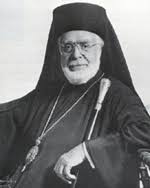
Archbishop Iakovos, 93, spiritual leader of Greek Orthodox Christians in the Western Hemisphere from 1959 to 1996, died April 10, 2005 from a pulmonary ailment.

Deeply respected by all religious leaders in the United States when he retired at the age of 85 on July 29,1996, Archbishop Iakovos offered 37 years of service which were distinguished by his leadership in furthering religious unity, revitalizing Christian worship and championing human and civil rights. He had the courage to walk hand in hand with Dr. Martin Luther King, Jr. in Selma, AL, a historic moment for America which was captured on the cover of LIFE Magazine on March 26, 1965. Friend to nine United States Presidents, Archbishop Iakovos was the recipient of the Presidential Medal of Freedom bestowed by President Jimmy Carter on June 9, 1980.

My piece of fiction, “Is the Pope Catholic“, may have caused some confusion — particularly after there seemed to be an Orthodox bishop participating in Friday’s papal funeral. But, like the article, all things are not as they seem. I received the following clarification regarding the TRISAGION PRAYERS OF MERCY which were conducted Friday at the Vatican near the close of the funeral of Pope John Paul II:

Those prayers (prayed in Greek and Arabic) were done by UNIATE clergy (also known as Greek Catholic, Byzantine Catholic, Eastern Rite Catholic, etc.) and not by Orthodox clergy. Even though Uniates may “look like us and sound like us,” they are not us. Their singing of “Khristos Anesti” and “Al-Maseeh Qaam,” during what for Orthodox is the middle week of the Great Fast, should have been a dead give away (being Uniates they celebrated Pascha with the rest of the Roman Catholic world). The Orthodox delegation to the funeral, headed by Ecumenical Patriarch Bartholomew of Constantinople, was seated together (opposite the world leaders) wearing no vestments and taking no part in any of the services. By the way, the man in full Byzantine episcopal vestments who presided over the Uniate’s Trisagion Prayers of Mercy was the Melkite (a term indicating an Arab Uniate of the Byzantine Rite) “Patriarch of Antioch, Alexandria and Jerusalem.”

Another site notes that the full title of the participant, the cleric who read the prayer O God of spirits and all flesh, His Holiness Gregory III Laham, the Melkite Greek-Catholic Patriarch of Antioch, is: Patriarch of the cities of Antioch, Alexandria and Jerusalem, of Cilicia, Syria, Iberia, Arabia, Mesopotamia, Pentapolis, Ethiopia, of all of Egypt and the entire East, Father of Fathers, Pastor of Pastors, Bishop of Bishops, the Thirteenth of the Holy Apostles and Judge of the World. (Now that’s a business card!)
Thanks to In principio erat Verbum.

In darker news, the ubiquitous & proudly practicing sodomite Episcopalian Bishop Gene Robinson (now there’s a title!) has been invited to Keynote the nation’s largest abortion chain’s, Planned Parentood’s, annual conference this month …

In an interview with Planned Parenthood, Robinson said, “We encourage our folks to take this very private issue seriously.

We urge them to talk to their priests about it and to think through all the questions they might have. And then we absolutely stand behind a woman’s right to choose.” He added a plug for Planned Parenthood’s “extraordinarily fine work.”

If you must, read more H E R E.
Thanks to OrthodoxyToday.

Posted in Uncategorized | Leave a comment

Out & About

Deacon Raphael reviews two books:

1) When Women Were Priests :Women’s Leadership in the Early Church and the Scandal of Their Subordination in the Rise of Christianity

2) The Gospel According to Women: Christianity’s Creation of the Sex War in the West.

A worthy read. Again, go HERE!

With this week, the Fifth Week of the Great Fast, upon us, I commend THIS ARTICLE about the Great Canon of St Andrew of Crete, Life of St Mary, and our common struggle.

Sign seen at a Church around Easter: “The Cross … the High Cost of Living.”

Another, during NCAA tourney: “Final Score: Satan – Zero … Christ – Won.”

Okay, I know, by now you’re groaning. But if I said, “Pray for me,” would you clap? A lot has been said about the applause after the Pope’s death and during the funeral. Someone told me that the Fox common tators said it was an Italian thing — like the way the Pope waves back to himself as if trying to smell St Peter’s Square. That too, says same someone, is an Italian thing. Just for the heck of it, next time someone asks me to pray for them, I think I’ll just give them a hearty round of applause. Ya think? OK, back to groaning. Elsewhere, Fr John chimes in (no applause, please).

The following notice, forwarded to me by a priest friend, is a timely reminder for all pious Orthodox …

Last week in Presanctified Liturgy this was chanted:

“The fast, the means of receiving blessings, hath now led us halfway through its course, pleasing God with the days that are past and proposing purposeful tasks for the days ahead; for the increase of blessings produces a greater number of good deeds. Therefore, let us cry to Christ, the giver of all blessings: O thou who didst fast and endure the cross for our sake, enable us to partake uncondemned of thy divine Pascha, to lead our lives in peace, worthily glorifying thee with the Father and the Spirit.”
— Sticheron from Vespers

Yesterday [4/6] was the 1/2 way point of the Great Fast. Time to renew our mind and refocus on the “purposeful tasks” for the remaining days. Who can benefit from your alms? Who could use a visit for encouragement? When will you confess? Let these last … weeks be purposeful!

Though I’ve been posting some Lenten Recipes, I’m sure my efforts lag behind necessity. You can find a host of recipes H E R E. Also, in the Huneycutt household, in between “fancy fasting”, there’s always black beans & rice (add salsa, onions, peppers, etc, to your liking). But, if you really want a helpful resource for your home, you may want to give this a try:

TASTE AND SEE
An Orthodox cookbook chock full of many [fasting] recipes.

$15, plus $5 for priority shipping.

Order from:

St. Ignatius Orthodox Church
4671 Peytonsville Road
Franklin, TN 37064

Posted in Uncategorized | Leave a comment