The Jesus Papers

Friends, when Elaine Pagels ends up representing “Orthodoxy” … you know something’s fishy.

The vinegar-soaked sponge
He says where the Gospels relate how a thirsty Jesus called out for something to drink. A sponge soaked in vinegar was placed on a reed and lifted to Jesus’ mouth. But rather than reviving him, Jesus died shortly after drinking the liquid. Baigent says that detail suggests how the plot might have been carried out.

Baigent: I think it’s more likely that they raised the sponge with some kind of anesthetic, which knocked Jesus out, which would reduce the trauma and make it easier for him to survive.

James: What do you think those drugs might have been?

Baigent: Well, they used hashish, opium, belladonna. There was a mixture of drugs.

If you’ve the time, read on.

Posted in Uncategorized | Leave a comment

Raising Boys

The following came from an anonymous Mother in Austin, Texas…

Things I’ve learned from my Boys (honest and not kidding):

1) A king size waterbed holds enough water to fill a 2000 sq. ft. house 4 inches deep.

2) If you spray hair spray on dust bunnies and run over them with roller blades, they can ignite.

3) A 3-year old Boy’s voice is louder than 200 adults in a crowded
restaurant.

4) If you hook a dog leash over a ceiling fan, the motor is not strong
enough to rotate 42 pound Boy wearing Batman underwear and a Superman cape It is strong enough, however, if tied to a paint can, to spread paint on all four walls of a 20×20 ft. room.

5) You should not throw baseballs up when the ceiling fan is on. When using a ceiling fan as a bat, you have to throw the ball up a few times before you get a hit. A ceiling fan can hit a baseball a long way.

6) The glass in windows (even double-pane) doesn’t stop a baseball hit by a ceiling fan.

7) When you hear the toilet flush and the words “uh oh”, it’s already too late to retrieve what ever it was.

8) Brake fluid mixed with Clorox makes smoke, and lots of it.

9) A six-year old Boy can start a fire with a flint rock even though a 36-year old man says they can only do it in the movies.

10) Certain Lego’s will pass through the digestive tract of a 4-year old
Boy.

11) Play dough and microwave should not be used in the same sentence.

12) Super glue is forever.

13) No matter how much Jell-O you put in a swimming pool you still can’t walk on water.

14) Pool filters do not like Jell-O.

15) VCR’s do not eject “PB &J;” sandwiches even though TV commercials show they do.

16) Garbage bags do not make good parachutes.

17) Marbles in gas tanks make lots of noise when driving.

18) You probably DO NOT want to know what that odor is.

19) Always look in the oven before you turn it on; plastic toys do not
like ovens.

20) The fire department in Austin, TX has a 5-minute response time.

21) The spin cycle on the washing machine does not make earthworms dizzy.

22) It will, however, make cats dizzy.

23) Cats throw up twice their body weight when dizzy.

24) 80% of Men who read this will try mixing the Clorox and brake fluid.

Thanks to FWD from blog reg, Keith.

Posted in Uncategorized | Leave a comment

April Fool’s Day

The following, written by Fr George Kevorkian, is a repeat from last year but pertinent to the day.

The historical origin of April Fool’s day actually deals with a very serious subject – the introduction of a new calendar. Ancient cultures as varied as the Romans and the Hindus had celebrated New Year’s Day on April 1, which is closely related to the start of Spring. In medieval times, much of Europe celebrated New Year’s Day on March 25th, the Feast of the Annunciation. In 1582, Pope Gregory ordered a new calendar, which has come to be known as the Gregorian Calendar to replace the older Julian Calendar. This new calendar called for New Year’s Day to be celebrated on January 1, instead of April 1. Many countries, however, resisted the change for centuries. Those who had accepted the change began to refer to the resisters as “fools” and would send them on fools errands, or try to trick them. In 1752, Great Britain finally adopted the Gregorian Calendar, but retained April 1 as a day for trickery.

As Orthodox Christians we are called to become fools to the things of this world, as a means of drawing closer to the things of God. We read in the teachings of St. Paul:

“Let no one deceive himself. If anyone among you seems to be wise in this age, let him become a fool that he may become wise. For the wisdom of this world is foolishness with God.” (1 Corinthians 3:18-19)

There is much “wisdom” in this world that we would be very wise to ignore. It may appear to be true, and even seductive, but this earthly wisdom denies God. Our only measure of true wisdom must be found in Christ, and we can only truly approach Him to the extent that we abandon the wisdom of this world that is in opposition to Him. It is in this sense that St. Paul calls us to become fools to this world, so that we may become wise to the things of God.

The Orthodox Church commemorates many Saints who took up the ascetic struggle of being “fools-for-Christ”. Two of the notable Saints are Andrew, Fool-for Christ-sake, and Basil, Fool-for-Christ-sake of Moscow. Both of these wonderful people led their lives appearing to be “insane” to the world as a means of putting aside the things of this world for the sake of drawing nearer to Christ. They wandered the streets of their cities hungry and half-naked so that they appeared to the world as outcasts. But in their “insanity” to this world, they became a consolation to others, and were given the gifts of prophecy and discernment.

It is especially relevant that this secular day of “April Fools” comes during the Orthodox Great Fast. In this Holy Season, we are called to turn away from the many distractions of the world, and to turn toward God. It is in this turning away from the distractions of the world that we indeed are called to become fools.

Previously published on the Antiochian webpage; used here by permission.

Posted in Uncategorized | Leave a comment

Who Was Constantine the Great?


My contribution to The DaVinci Dialogue is now up.

H E R E.

Posted in Uncategorized | Leave a comment

ST NILUS ISLAND: Alaska (Pt 5)

By God’s grace & your prayers, I’m back in Houston. I have a couple more photo-blog installments, this one continues our pilgrimage …


After Monk’s Lagoon, we seven pilgrims headed to St Nilus Island, home of St Nilus Skete — a dependency of St Herman of Alaska Brotherhood — to take provisions to the two nuns there: Mothers Nila & Nina.


Our skiff approaches the beautiful beach of St Nilus Island.


Archpriest Chad Hatfield, Dean of St Herman Seminary, was our tour guide. Here, he leads the way (after the photographer, of course).


Another shot of St Nilus beach.


Can you find the St. Nilus of Sora Chapel?


Well, lets walk around to the path …


This picture is taken from the path leading down the hill, the opposite direction.


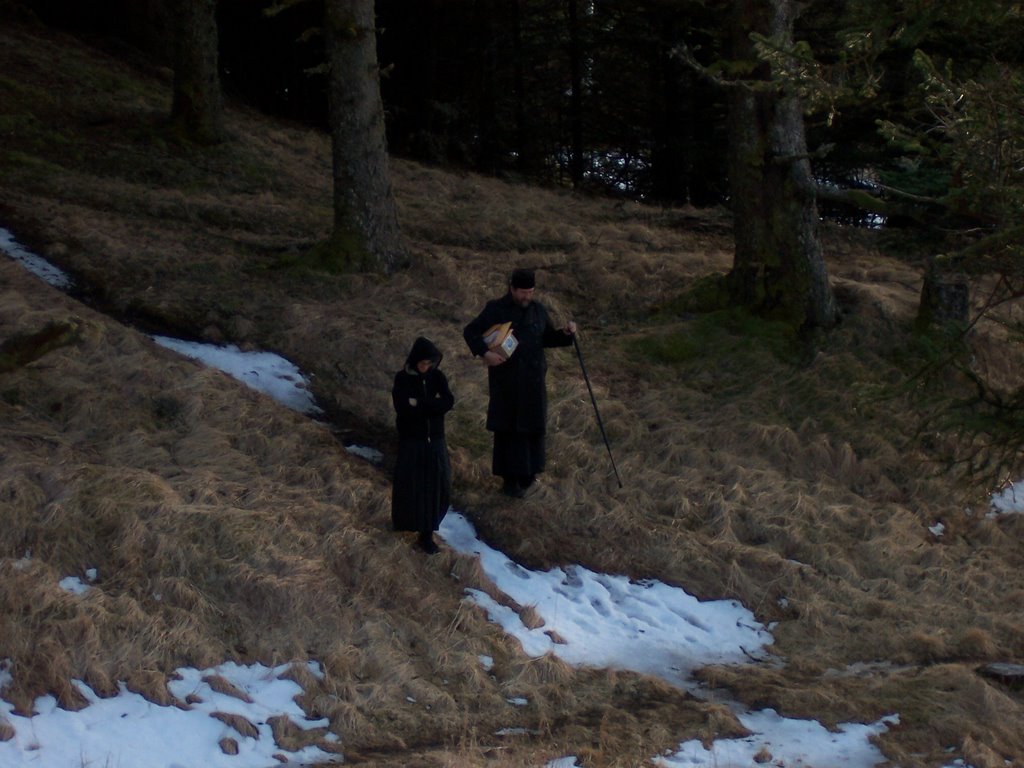
Priest & Monastic in Alaskan forest.


The return to the beach, awaiting the boat.


This pic is taken to show the clarity of the water. Can you see the ocean floor? This is probably 4 feet deep.


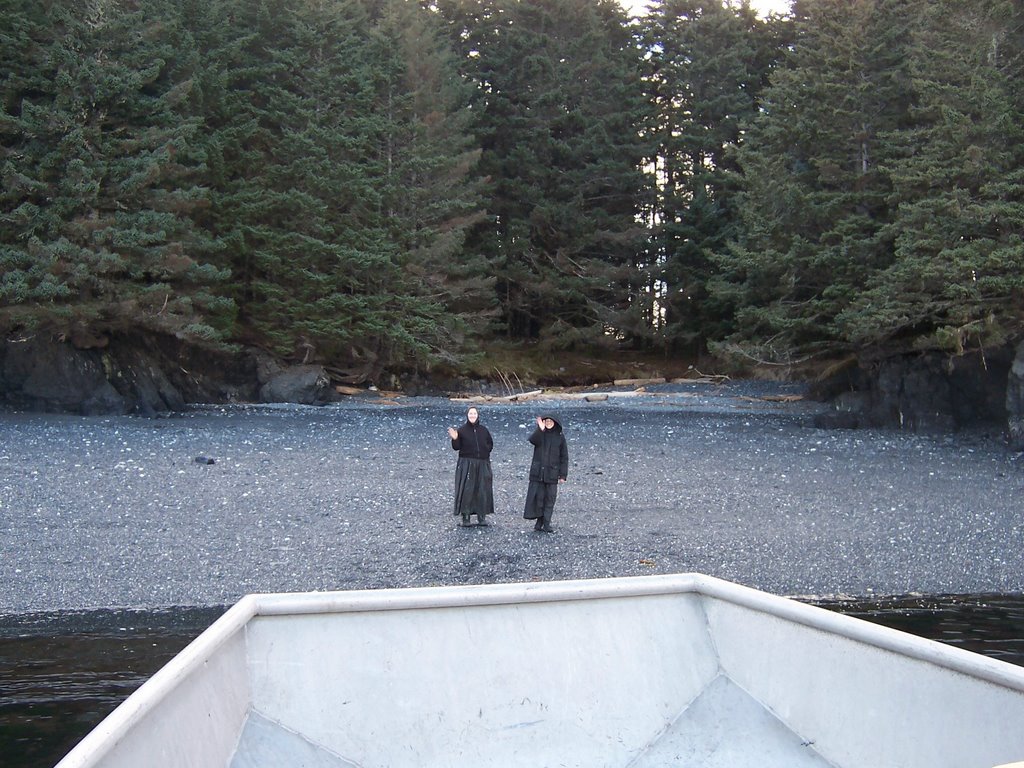
Nuns waving goodbye to pilgrims.


The water was very choppy on the return trip, clouds were moving in. After a long skiff ride on the sea, St Paul’s Harbor is a welcome site.

Later, pics from St Herman Seminary & St Innocent Academy.

Posted in Uncategorized | Leave a comment