
 More on Mary, Mother of God.
Jack Black is Herod in JC Superstar revisited.
HT Thunderstruck
The church of the Life-Giving Trinity consecrated in Pyongyang.
More on Mary, Mother of God.
Jack Black is Herod in JC Superstar revisited.
HT Thunderstruck
The church of the Life-Giving Trinity consecrated in Pyongyang.
 When Pope Benedict XVI revealed his appreciation for the “Funny Side of Life” (scroll to end of article), I believe it’s safe to say he was NOT talking about this — a sad and pathetic story of two men, Episcopal priests, wanting to get “married” to each other.
Now that’s just not funny!
What would be funny about gay marriage?
But, there’s a lot of laughs allotted the married state and I believe the Pope probably had something more like these in mind:
While attending a Marriage Seminar dealing with communication, Tom and his wife Grace listened to the instructor, “It is essential that husbands and wives know each other’s likes and dislikes.”
He addressed the man, “Can you name your wife’s favorite flower?”
Tom leaned over, touched his wife’s arm gently and whispered, “It’s Pillsbury, isn’t it?”
* * * * *
Morris and his wife, Esther went to the State Fair every year. Every year, Morris would say, “Esther, I’d like to ride in that helicopter.” Esther always replied, “I know Morris, but that helicopter ride is 50 dollars … and 50 dollars is 50 dollars.”
A few years later, Esther and Morris went to the fair. Morris said, “Esther, I’m 85 years old. If I don’t ride that helicopter now, I might never get another chance.”
Esther replied, “Morris, that helicopter is 50 dollars and 50 dollars is 50 dollars.”
The pilot overheard the couple. He said, “Folks, I’ll make you a deal. I’ll take the both of you for a ride. If you can stay quiet for the entire ride and not say a word, I won’t charge you! But if you say one word, it’s 50 dollars.”
Morris and Esther agreed — and up they went.
The pilot did all kinds of fancy maneuvers, but not a word was heard. He did his daredevil tricks over and over again, but still not a word.
When they landed, the pilot turned to Morris and said, “By golly, I did everything I could to get you to yell out, but you didn’t. I’m impressed!”
Morris replied, “Well, I was going to say something when Esther fell out, but 50 dollars is 50 dollars.”
Both the beyond-the-pale Episcopalian link (sad, not funny) and the clean jokes are thanks to e-notes from parishioners.
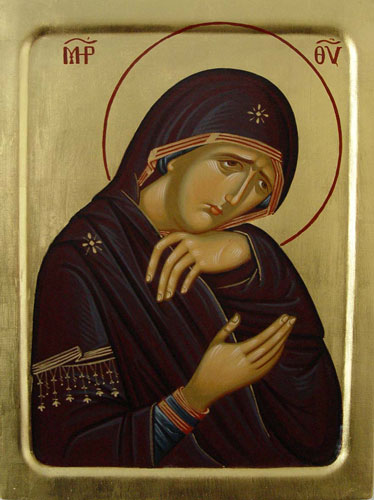 HYMN OF PRAISE
The Most-holy Theotokos
Thus spoke the Lord Most-high:
“From thy heart, pure Virgin,
Living water will flow,
That those who thirst will drink Christ.”
— Life bearing source,
— We all boast of thee!
Those who thirst will drink Christ.
By Him, the bitter is sweetened;
By Him, the scales are washed from blind eyes;
And by Him, the grief of those in sorrow is healed.
— Life bearing source,
— We all boast of thee!
Sweet drink sprung from eternity,
The brook filling our arid age:
Once more raised toward heaven,
Our exhausted world becomes refreshed.
— Life bearing source,
— We all boast of thee!
Glory to thee, O Most-pure One!
Glory to thee, O Mother of God!
Thou didst bear for us the Living Christ,
The living water of grace!
— Life bearing source,
— We all boast of thee!
St Nikolai Velimirovic, The Prologue of Ohrid, Volume Two, p.184.
To read the story of the Falling Asleep (Dormition) of the Mother of God, Go HERE.
A couple years ago, after being loaned a book by Max Lucado, I posted a piece entitled ALMOST … All Generations Will Call Me Blessed (now edited) — wherein I lament the “lack of Mary” among our Protestant brethren.
Later I noted …
Regarding my post of July 9th on a book by Max Lucado … yes, I did finish the book. No, I certainly can’t recommend it for Orthodox. But, being fair, for many in the Protestant world, this sort of positive-mental-attitude-for-Jesus collection of meditations is a small form of “therapy.” It’s unrealistic of me to believe that, being Protestant, there’s hope of proper appreciation for Mary, the Mother of God. That being said, there’s a need, I’ve come to believe, within Orthodox America for lighter fare within an Orthodox context. Not everyone is going to become proficient in reading the Church Fathers, Vladimir Lossky, and the like.
You can watch & listen to a sermon on the Dormition of the Theotokos, in Greek & English, by Archbishop Demetrios of the Greek Archdiocese by clicking HERE.
To those Orthodox & Catholics celebrating today’s Feast, to those still persevering in the Dormition Fast, and even to those yet to honour the Mother of God … through her prayers, may God grant good health and many years!

The following is from DYNAMIS, August 10, 2006 …
Speaking In Tongues:
1 Corinthians 14:6-19, especially vs. 19: “yet in the church I would rather speak five words with my understanding, that I may teach others also, than ten thousand words in a tongue.”
The spiritual gift of speaking in tongues appeared among Christians in the earliest days of the Church, as both the Acts of the Apostles (Acts 10:46; 19:6) and St. Paul report (1 Corinthians 14:6-19). Not long after, tongue-speaking became the focus of the heretical Montanist sect in Phrygia, a group that flourished from the 2nd to the 9th century.
It should be noted that as a phenomenon tongues have not been limited to Christians – Orthodox or heterodox. Plato, among the pagan Greeks, and Virgil, among the ancient Latins, report tongue-speaking in various pagan rites. During the Middle Ages, tongues was practiced in Europe by mendicant friars, and later by Quakers and Methodists. The practice enjoyed a revival during the 19th and 20th centuries among certain Evangelical Protestant congregations, such that whole denominations formed, emphasizing tongue speaking. Then, in the later 20th century, tongues spread among many mainline western Churches, e.g., Anglicans and Roman Catholics.
The Apostle Paul himself spoke in tongues, considering it a gift from God for which he gave thanks (1 Cor. 14:18). However, note carefully in today’s reading, that as St. Paul speaks about this practice one is able to discern his cautions concerning tongue speaking.
A reading through the passage immediately discloses the Apostle’s point of view that this vocal gift from the Holy Spirit (vss. 12,18) ought to be a matter of private prayer and be avoided in public, corporate worship (vss. 6,9,19). His reasoning is quite straightforward: there are “many kinds of languages in the world” (vs. 10), and if one does “not know the meaning of the language” he is made a foreigner simply because he cannot understand what he hears (vs. 11).
Also observe: the present passage rejects the opinion of those who relegate speaking in tongues to merely psychological causes. Such opinions disregard St. Paul’s manifest assumption that tongues can be a gift of the Holy Spirit (vss. 12,18). However, while God the Holy Spirit may give tongues, He also will give the “discernment of spirits” (1 Cor. 12:10). Note also, evidence from comparative religions suggests that not all speaking in tongues is of God. Some does indeed come from demonic sources and from darkened or immature human psyches.
As an Apostle, St. Paul was one sent by the Lord Jesus, a man under necessity to preach the Gospel and at grave spiritual risk for refusing to do so (1 Cor. 9:16). Today’s passage clearly shows the unceasing urgency in him to communicate the good news. Hence, St. Paul was mostly concerned for understanding among his hearers, a concern that included occasions when he prayed with other people, especially in worship with those new to the Faith (vss. 6,9,11,16).
Continually planting churches in communities where the Christian message never had been heard, St. Paul bore a responsibility for these congregations he brought into existence – as in the case of the church at Corinth. The present passage reveals his concern for such congregations – that they develop as communities wherein their members would grow in spiritual knowledge – again, that primary concern for edification (vss. 12,19) and he insists that tongues should remain a matter of private devotions, so as not to confuse congregations.
Following the Apostle’s concern that prayer, hymns, and blessings should be understood (vss. 15,16), the Orthodox Church continues to resist the introduction of tongues into corporate worship, fearing possible confusion in the understanding of the Faithful.
Light is the Father; and Light the Son; Light is the Holy Spirit descending upon the Apostles through which the whole universe was illuminated to worship the Holy Trinity.
To enroll to DYNAMIS daily e-meditations send an email to:
orthodoxdynamis-subscribe@yahoogroups.com
Or, visit them on the Web HERE.
 Direct the course of our lives, Lord, straight towards you, so that in you we may reach you, and so that in you we may find you. Make us worthy to attain to you, in you; and let us behold nothing beside you. Hide everything from our mind’s vision by means of the manifestation of your glorious Light.
For whoever gazes upon you does not need to look upon anything else; but whoever does not gaze upon you is in need of all kinds of other sources of illumination in order to be able to see.
Praise to you for you are the Light, and in you our souls have illumination. You illumine all with knowledge of yourself. Draw back the veil of falsehood from our souls so that we can see your Light clearly, for our minds are not totally dark owing to love of you.
— John of Apamea, in, “The Syriac Fathers On Prayer And The Spiritual Life,” translated from the original Syriac-Aramaic by Sebastian Brock, Cistercian Publications.
Stolen from a Christian Mysticism list.

